Cognitive Submission: Why Contractors Can’t Outsource Their Judgment to AI
“Cognitive Submission” describes humans who defer their own reasoning, judgment, and analytical effort to an AI system rather than engaging critically with it. I am as enamored with AI as anyone. In fact, I look forward to the day when I no longer marvel at how it shapes my ideas, documents, spreadsheets, and graphics into a well-crafted deliverable.
We are currently piloting AI tools to synthesize data, refine our documents, and drive efficiency within our growing construction operation. I have arrived at a few strong opinions: AI is going to change how we work forever; it is very powerful and efficient; it can replace much of the software and task-oriented functions in our daily business. And, it is imperfect for now.
In our pilot experiment, we are crunching look ahead schedules, completion lists, concept budgets, market analysis, polishing proposals, refining safety plans, reviewing contracts, and even toying with logistics planning. In the past few months, we have compressed the time to task for contract reviews, task-oriented functions related to project management, and built new workflows using custom APIs to support safety training and data management.
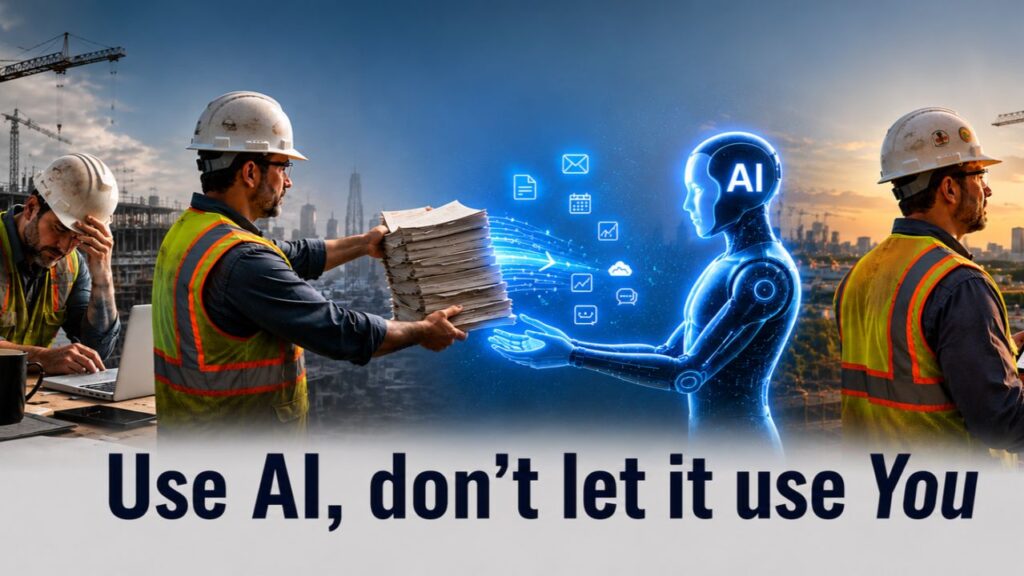
While AI is quite amazing on many fronts, it still makes mistakes. Use AI, don’t let it use you. Guess what, it is 100 times more effective than it was three years ago when everyone started to experiment with OpenAI. It is the future and it absolutely will drive efficiency in construction.
Let’s face it, construction is rarely on-trend with technology adoption in the US. We are laggards compared to healthcare, banking, and technology sectors. However, this may be our moment in time. The construction industry is fragmented with inefficient bureaucracies, conflicting codes and specifications, and disparate processes regarding building standards and inspections. We also experience varying levels of technical expertise ranging from craftworker training to project management sophistication. Finally, we do not have a central marketplace to exchange our services like banking, manufacturing, or technology. My point: We have a lot of upside potential for continuous improvement!
Name more than a handful of commercial construction companies that are publicly traded! They don’t exist because our industry is too fragmented and complex. Margins are thin, project-based risk is extreme compared to parallel industries, and no consortium of companies has market dominance. We are trying to bring the manufacturing process to the outdoors where the conditions are never the same; whereas an iPhone is built in a clean environment with six sigma levels of quality assurance where hundreds of thousands of units are produced daily.
The advent of AI may help us standardize and reduce variability within our building systems. What if we used AI as an aid to standardize our building codes and resolve the conflicts within our voluminous building standards? What if AI can consolidate the public information on commodities pricing and we agree on a uniform way to price our lumber, cement, sheet goods, and steel components? What if we could consolidate the myriad of project management, accounting, and precon systems to work in unison via an AI solution? What if we could use data analytics to inform our production rates?
We may be able to harness the technology to reduce risk to our own firms and those for whom we contract with in the future. AI technology is promising and offers us a new path to elevate our industry to be on par with the brands we often cite with admiration.
Back to “cognitive submission”. If we don’t leverage AI, we will become more obsolete than we arguably are. With a caveat – we need to continue to use our brains and know-how to inform the AI we use, not the other way around. Don’t get lazy and think AI will spit out a high-fidelity budget to roll out at your next client presentation. Don’t coax yourself into thinking that the AI can generate a great schedule and logistics plan to manage your site and trade coordination without your scrutiny. Don’t rest easily because you ran a contract through your AI for conflicts and risk mitigation without reading it for yourself before and after.
AI is a tool – it may be the most powerful tool we have ever had at our fingertips. But people still build buildings through craft labor. Relationships are still built on trust between clients, contractors, suppliers, and consultants. We still need to do the work, but AI may enable us to do our work with more predictability, consistency, and hopefully enhances the quality and the status of our industry as a whole.

Ben Wilhelm is President and COO of McFarland Construction, a commercial general contractor and construction manager, headquartered in Charlotte, NC with operations across the Southeast and Midwest, serving energy, mission critical, health sciences, financial, and public sectors.