Nearly 40% of Planned Weekly Work on Construction Sites Isn’t Delivered
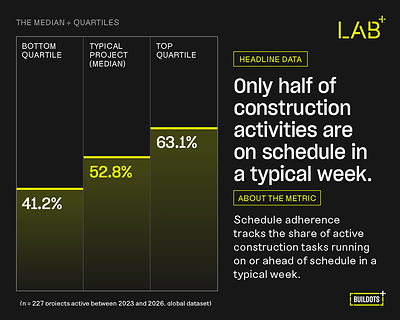
The Buildots Intelligence Lab today announced the launch of its inaugural Global Construction Benchmarks Report, which establishes a new type of benchmark based on anonymized, aggregated data from hundreds of global construction projects across five verticals. According to the report, in a typical week: just 29.3% of construction activities actually start on time, 52.8% of active construction work stays on schedule, and 37% of planned work remains undelivered.
The materials and equipment contractors buy have long been standardized down to a market price that can be checked instantly. And while rate books have told estimators what a crew should theoretically install for decades, no one has ever continuously measured what construction actually delivers, week by week, against the plan. This report does exactly that, turning real data into a set of objective benchmarks.
The activity-level benchmarks in the new report include schedule adherence, on-time starts, completion overrun, planned-vs.-actual production, peak-vs.-typical performance, and trade-level reliability across 21 core construction activities.
Among the report’s key findings:
- Nearly half of all active construction work is behind schedule in a typical week – sites keep just 52.8% of activities on schedule.
- The typical construction activity finishes 5.3 weeks late, but performance varies sharply. Top-quartile projects hold that to 2.3 weeks, showing that fast, reliable delivery is achievable.
- Nearly 40% of planned weekly output is not delivered. The typical project delivers just 63% of its planned output, leaving 37% of planned work volume undelivered in a typical week.
- Nearly every construction activity under-delivers its planned weekly output. 20 of 21 activities measured fell short of plan, ranging from 38% (resilient/soft flooring) to 122% (drywall framing, the only activity to exceed plan).
- 70.7% of construction activities miss their planned start date. Just 29.3% of activities actually start on time.
“Everything else that goes into a building has long been standardized – equipment, materials, specs. But one thing that hasn’t been is the work itself,” said Amir Berman, VP of Industry Transformation at Buildots and head of the Intelligence Lab. “This report is a step toward changing that: turning construction activity into repeatable, measurable units, so we can finally answer how much a project can actually build in a given timeframe, and how wide the gap is between a typical week and a top-performing one.”
An ongoing construction benchmark series
The Global Construction Benchmarks Report is the first release in an ongoing Buildots Intelligence Lab research series. Having established a global baseline, the Lab will next apply the same methodology to sector-specific and regional editions – starting with data centers and healthcare – sharpening these global reference points into benchmarks that project teams can hold a specific project to.
“You can’t fix what you can’t measure, and the construction industry has always lacked a source of macro-level truth about its own performance,” said Roy Danon, Co-founder and CEO of Buildots. “Establishing objective, data-driven benchmarks like these is central to our mission at Buildots, and these findings show exactly why. This report proves strong performance already exists in the industry, it’s just inconsistent. Revealing that is the first step toward helping every construction project, portfolio, and organization perform at its best.”
The full Global Construction Benchmarks Report, including sector breakdowns, quartile data, and detailed production-rate tables for 21 core construction activities, is available at: https://buildots.com/lab/global-construction-benchmarks-report/