AI Is Becoming Construction’s Next Leadership Test
Artificial intelligence may be the biggest technology story in construction today. But increasingly, I believe we are looking at it through the wrong lens.
The most important AI question facing contractors is no longer:
What can the technology do?
It is:
What does leadership need to do differently because the technology exists?
That distinction matters.
The latest research suggests AI is moving beyond experimentation and into something much more consequential: organizational transformation. McKinsey reports that most companies remain relatively early in their AI journeys and that individual adoption alone rarely translates into lasting enterprise advantage when the organization around the technology remains unchanged.
IBM’s 2026 CEO Study reaches a similar conclusion. Sixty-nine percent of CEOs say AI is already changing parts of their businesses they consider core, while 77% say technology and talent leadership roles are converging.
For construction leaders across the Carolinas, that should get our attention.
Because AI isn’t simply coming for our software.
It is coming for our workflows, organizational structures, talent models, management practices and ultimately the way we lead.
The Conversation Is Moving Beyond AI Tools
The first stage of AI adoption in construction has largely been about tools.
Can AI write a proposal?
Summarize a meeting?
Analyze a contract?
Search project documents?
Help with an estimate?
Develop a schedule?
Create a safety plan?
Those are useful questions, and there is significant value available from them.
But they are first-generation questions.
The more strategic question is what happens when we connect those capabilities across an entire workflow.
Consider preconstruction.
A contractor might use AI to summarize an RFP, another application to analyze drawings, another to research the owner, another to develop pursuit strategy and another to draft proposal content.
That improves individual tasks.
But imagine redesigning the entire process.
An AI-enabled system could eventually help identify an opportunity, analyze whether it fits the company’s strategy, evaluate historical project performance, assess customer relationships, identify risks, compare available resources, recommend a go/no-go decision and begin developing the pursuit strategy.
Now we aren’t improving a task.
We are redesigning how work gets done.
That is fundamentally a leadership conversation.
AI Will Force Leaders to Rethink the Organization
McKinsey’s 2026 State of Organizations research, based on more than 10,000 senior executives, identifies technology and AI as one of three major forces reshaping organizations, alongside economic and geopolitical disruption and changing workforce expectations.
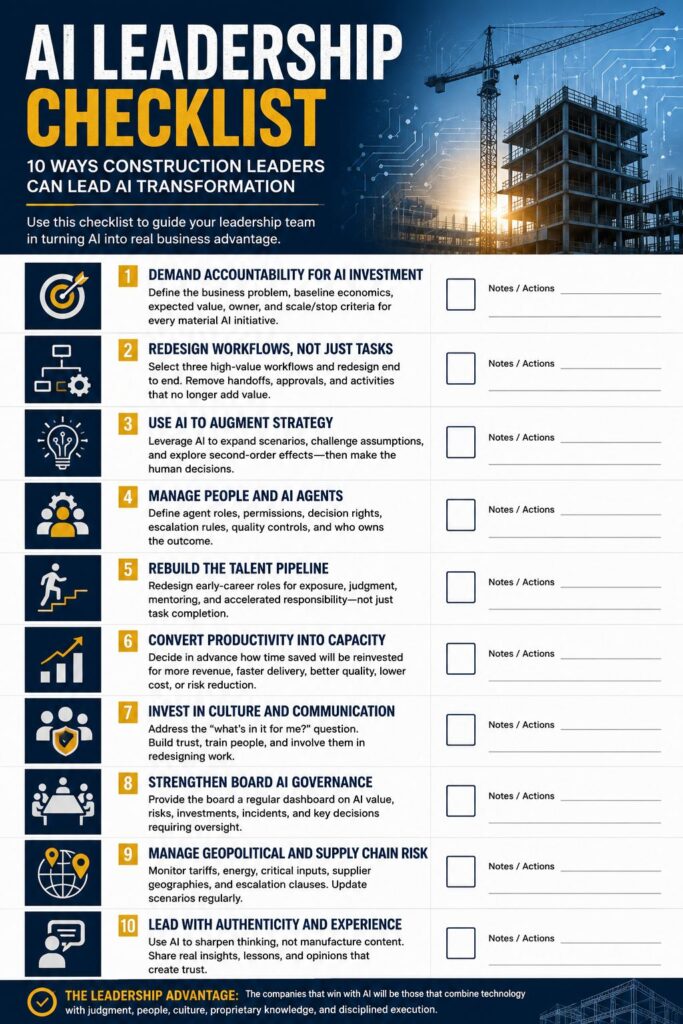
In my book Building Smarter with AI, I make the case that AI is not simply a technology initiative—it is a leadership and business transformation imperative. For construction leaders, the opportunity is to move beyond experimenting with tools and start redesigning how their organizations make decisions, develop people, execute work, and create competitive advantage.
Construction will not be exempt.
Think about the organizational structure of the typical contractor.
Estimating.
Preconstruction.
Operations.
Project management.
Safety.
Business development.
Marketing.
Finance.
Human resources.
Technology.
Many of those functions were designed around an era when information was scarce, analysis took time and coordination required layers of people.
AI changes that equation.
Some information gathering can happen instantly.
Reports can be generated automatically.
Large quantities of project data can be analyzed in seconds.
Routine administrative work can increasingly be performed by AI agents.
That doesn’t mean management disappears.
It means the value of management changes.
The manager of the future will spend less time collecting information and moving it through the organization and more time exercising judgment, coaching people, solving problems, allocating resources and making decisions.
That is an important distinction for construction companies thinking about organizational design over the next five to ten years.
Leadership Becomes More Important, Not Less
There is a temptation to believe increasingly capable AI will reduce the importance of leadership.
I believe the opposite is likely to happen.
McKinsey makes an important point in its research on leadership in the age of AI: AI can write, analyze, code and complete tasks at extraordinary speed, but it cannot perform some of the fundamental work of leadership—setting aspirations, making difficult choices, creating trust and holding people accountable.
Those capabilities become more valuable when technology makes everything else faster.
Construction leaders will increasingly need to answer questions machines cannot answer for us.
Which markets should we pursue?
Which customers deserve our resources?
Which risks should we accept?
Where should we invest?
What kind of company do we want to become?
What work should we walk away from?
How should we treat people when technology changes their jobs?
AI can provide information.
It can generate scenarios.
It can challenge assumptions.
It can even recommend a decision.
But leadership still owns the consequences.
The best leaders will learn to think with AI without allowing AI to think for them.
The Career Ladder Is About to Change
One of the most consequential AI trends may have little to do with technology.
It involves how we develop people.
PwC’s 2026 Global AI Jobs Barometer analyzed more than one billion job advertisements and found that skills in AI-exposed jobs are changing more than twice as fast as in less-exposed jobs. Even more interesting, AI-exposed entry-level positions are seven times more likely to require capabilities traditionally associated with senior employees, including judgment and leadership.
That has major implications for construction.
For decades, we have developed young professionals through progressively more difficult work.
Project engineers learn documentation.
Estimators perform takeoffs.
Marketing coordinators develop first drafts.
Assistant project managers manage increasingly complex responsibilities.
Eventually experience produces judgment.
But AI is beginning to automate portions of the very work that historically created that experience.
That presents a leadership challenge.
If we remove the first three rungs of the ladder, how does someone reach the fourth?
Construction companies will need to rethink apprenticeship.
Young professionals may need customer exposure earlier.
Field experience earlier.
Decision-making earlier.
Mentoring earlier.
Financial responsibility earlier.
Instead of spending years producing information, they may need to learn earlier how to evaluate information and exercise judgment.
Done poorly, AI could weaken construction’s future leadership pipeline.
Done well, it could accelerate it.
The Human Skills May Become the Premium Skills
Another interesting finding from PwC’s research is that AI does not appear to be making human capabilities obsolete.
In many cases, it is making them more valuable.
Judgment.
Leadership.
Creativity.
Communication.
Relationships.
Problem solving.
AI increasingly handles portions of routine production while people move toward higher-value activities. Companies most exposed to AI are also showing stronger productivity growth, suggesting that the winners may be organizations that amplify human capability rather than simply eliminate labor.
This is particularly relevant in construction.
Construction is fundamentally a relationship and judgment business.
Owners still need confidence in their contractors.
Superintendents still need to lead people.
Project executives still need to resolve difficult situations.
Business developers still need to build trust.
Leaders still need to make decisions when the information is incomplete.
Technology changes the tools.
It doesn’t eliminate the need for leadership.
Productivity Is About More Than Hours Saved
AI discussions frequently focus on productivity.
Someone saves five hours preparing a proposal.
A project manager saves three hours preparing reports.
An estimator analyzes information twice as quickly.
Those are real benefits.
But there is a leadership question hiding underneath them:
What happens to the time we save?
If AI saves five hours and those five hours simply become five additional hours of meetings, emails and administrative activity, the company has not necessarily become more productive.
Leadership must decide how released capacity gets redeployed.
Could a project manager spend more time in the field?
Could an estimator evaluate more opportunities?
Could a business developer spend more time with customers?
Could a superintendent spend more time coaching younger employees?
Could a safety professional spend more time preventing incidents instead of preparing reports?
Could the company pursue more work without adding overhead at the same rate?
Those are enterprise productivity gains.
The most important AI metric in construction eventually may not be hours saved.
It may be what the organization does with the hours it gets back.
Culture Is Part of the AI Strategy
Deloitte’s 2026 Human Capital Trends research makes another important point: technology itself is increasingly replicable. Competitive differentiation comes from how organizations combine technology with human adaptability, creativity and judgment. Deloitte found organizations taking a primarily technology-focused approach to AI were more likely to fall short of expected returns than those taking a more human-centered approach.
That should resonate with construction leaders.
You cannot mandate transformation through an email announcing a new AI platform.
Employees are asking legitimate questions.
Will this change my job?
What skills should I learn?
Can I trust the technology?
How will my performance be measured?
What happens when AI makes a mistake?
Is the objective to make me better—or eliminate my position?
Leadership needs answers.
Companies that communicate clearly, establish sensible guardrails, invest in AI literacy and involve employees in redesigning work will have an enormous advantage over organizations that simply deploy technology and expect adoption.
AI implementation is change management.
And change management is leadership.
The Competitive Advantage Isn’t AI
There is one final point construction executives should consider.
Eventually, almost every contractor will have access to powerful AI.
The models will improve.
Construction software will incorporate AI.
Owners will expect it.
Employees will use it.
AI itself therefore may not provide lasting competitive advantage.
What will?
Your historical estimating information.
Your productivity data.
Your project experience.
Your customer relationships.
Your lessons learned.
Your safety knowledge.
Your field expertise.
Your operating processes.
Your culture.
Your people.
AI can amplify those assets.
But competitors cannot simply download them.
That means the strategic opportunity isn’t merely adopting artificial intelligence.
It is combining AI with the institutional intelligence already inside the company.
The Leadership Question
Construction has experienced major technology shifts before.
BIM changed coordination.
Mobile technology changed field communication.
Cloud computing changed access to information.
Drones changed documentation.
Digital project-management platforms changed collaboration.
AI is different because it touches almost everything simultaneously.
It affects how we analyze information.
How we make decisions.
How we organize work.
How we develop people.
How we measure productivity.
And eventually, how we design organizations themselves.
That is why I believe AI may become one of the biggest leadership challenges of our generation.
Not because the technology is difficult to understand.
But because leaders must decide what their organizations should become when intelligence itself becomes inexpensive, abundant and increasingly embedded in everyday work.
The winners will not necessarily be the contractors with the most AI tools.
They will be the contractors with leaders who can combine technology with judgment, people, culture, proprietary knowledge and disciplined execution.
AI may be the technology story of the decade.
But for construction, the bigger story may ultimately be leadership.