AI Is About to Rewire Construction. Here’s What It Means for Contractors in the Carolinas
A new McKinsey analysis suggests artificial intelligence could reshape far more than construction productivity. For contractors across North and South Carolina, the bigger question is who will control the data, workflows, customer relationships—and ultimately the value—of the next construction operating model.
For the past several years, much of the construction industry’s conversation around artificial intelligence has centered on relatively simple applications: writing emails, summarizing documents, creating proposals, searching specifications and saving administrative time.
That conversation is about to get much bigger.
In its July 2026 report, How AI Is Reshaping the Future of the AEC Industry, McKinsey & Company argues that AI is moving beyond isolated productivity tools toward something far more consequential: the potential restructuring of how architecture, engineering and construction companies actually operate. McKinsey’s central message is straightforward: firms that move quickly to redesign workflows, improve how they use data and automate elements of project delivery will be positioned to thrive.
For contractors in the Carolinas, this deserves attention.
Not because AI is suddenly going to replace superintendents, project managers, estimators or skilled craft professionals. McKinsey specifically argues against viewing AI as an extinction event for AEC companies.
The bigger possibility is that AI changes which contractors outperform, how projects are delivered, where margins are created and who controls the most valuable parts of the construction process.
And that shift may happen faster than many companies expect.
The $228 Billion Opportunity
The scale of the opportunity is significant.
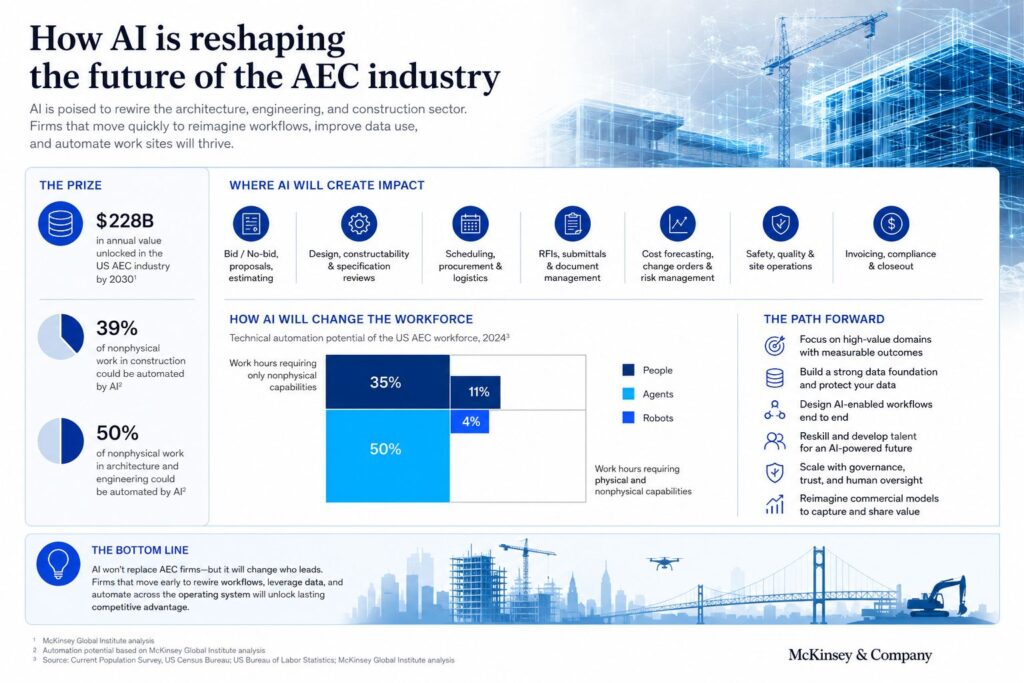
McKinsey Global Institute estimates that AI and other automation technologies could unlock approximately $228 billion in annual value in the U.S. AEC industry by 2030. At the same time, AI potentially could automate approximately 39% of nonphysical work in construction and 50% in architecture and engineering.
That matters in an industry that has struggled with productivity for decades.
McKinsey notes that construction productivity improved only 10% between 2000 and 2022—approximately 0.4% annually—compared with a 90% improvement in manufacturing. Meanwhile, global construction demand is projected to grow from roughly $15 trillion in 2025 to as much as $22 trillion by 2040.
That creates a fundamental problem.
We need to build considerably more infrastructure, manufacturing capacity, data centers, power infrastructure, healthcare facilities, housing and other assets without a corresponding increase in available construction talent.
That equation does not work without productivity improvement.
AI could become part of the answer.
The Biggest Change May Not Be in the Field—At Least Not Yet
When people hear “AI in construction,” they often jump immediately to robots building buildings.
McKinsey’s timeline is more pragmatic.
The near-term opportunity is primarily about eliminating friction from the enormous amount of information and coordination work surrounding construction.
Think about how much time contractors currently spend moving information between estimating, preconstruction, procurement, project management, accounting, engineering, VDC and field operations.
McKinsey identifies several areas where AI-enabled workflows could begin creating significant value over approximately the next 18 months: bid/no-bid decisions, proposal development, estimating and pricing; constructability and specification reviews; scheduling and procurement; RFIs and submittals; cost forecasting and change-order management; safety and quality; invoicing, document control and compliance.
These aren’t futuristic construction activities.
They happen inside Carolina contractors every day.
The important distinction is that McKinsey isn’t advocating simply putting an AI tool on top of each activity.
The real opportunity comes from connecting them.
Imagine a schedule change automatically checking procurement status, identifying affected subcontractors, evaluating cost implications, reviewing field conditions and recommending recovery options.
That is considerably different from asking ChatGPT to summarize a meeting.
From AI Tools to AI Coworkers
One of the most interesting scenarios in the McKinsey report starts with something every contractor recognizes.
A superintendent discovers that prefabricated pipe spools no longer fit because of a late engineering change.
Today, resolving that problem might require RFIs, drawing reviews, procurement checks, schedule analysis, cost assessments and coordination across multiple teams.
McKinsey describes a future where the superintendent photographs the problem and AI agents compare that image against the latest model, drawings, procurement records and schedule. The system identifies possible causes, checks material availability, estimates cost and schedule impacts and recommends alternatives.
Humans still make the critical decisions.
But instead of spending days assembling information, the project team could be evaluating solutions within hours.
That distinction is important.
AI doesn’t eliminate accountability. It compresses the distance between a problem and a decision.
For contractors operating increasingly complex projects across Charlotte, Raleigh-Durham, the Upstate, Charleston, Columbia and other growing Carolina markets, that capability could become a meaningful competitive advantage.
Your Project History May Become One of Your Most Valuable Assets
Perhaps the most strategically important section of McKinsey’s analysis has little to do with software.
It is about data.
Every established contractor has accumulated years—sometimes decades—of project intelligence:
Estimates. Schedules. Productivity information. RFIs. Change orders. Safety observations. Procurement history. Cost data. Lessons learned. Closeout documents. Customer information. Constructability knowledge.
Most organizations treat those records as documentation.
AI potentially turns them into institutional intelligence.
McKinsey argues that firms capable of connecting estimates to actual results, schedules to real progress, design decisions to constructability outcomes and risk decisions to claims data could create self-improving systems.
That creates a fascinating competitive dynamic.
A generic AI model may understand construction.
Your data understands how your company constructs.
It knows what productivity your crews actually achieve. Which estimates were accurate. Which suppliers performed. Which sequencing decisions worked. Which project risks became claims. Which customers behave in certain ways. Which lessons were learned the hard way.
The contractor that can capture and reuse that knowledge may develop an advantage that competitors cannot easily buy.
The Institutional Knowledge Problem
This is particularly important given the demographic challenge facing construction.
Contractors throughout the Carolinas have experienced professionals who know things that aren’t written anywhere.
They have “seen this movie before.”
They recognize a problematic detail on a drawing because they encountered something similar 15 years ago. They know when an estimate feels wrong. They recognize scheduling assumptions that won’t survive contact with the field.
McKinsey describes AI’s potential to capture lessons from schedules, RFIs, change orders and individual project decisions and make those lessons available within everyday workflows. A younger planner, for example, could receive a warning about a sequencing problem that historically only an experienced scheduler would recognize.
That could dramatically change knowledge transfer.
Instead of asking:
“How do we replace 30 years of experience?”
Contractors may increasingly ask:
“How do we capture 30 years of experience before it walks out the door?”
But There Is a Leadership Catch
There is another side to this.
Many of the tasks AI can automate are the same tasks young professionals historically used to learn the business.
Junior employees learn estimating by estimating.
Project engineers learn documentation by managing documentation.
Young project managers develop judgment by working through hundreds of relatively small problems before being asked to manage very large ones.
If AI performs those activities, companies could inadvertently remove part of their leadership-development pipeline.
McKinsey warns that firms may need to become much more intentional about developing junior talent through structured reviews, simulations, explicit standards and exposure to actual project failures and decisions.
That may become one of construction leadership’s most overlooked AI challenges.
We can’t automate the apprenticeship and then wonder where the experts went.
Specialty Contractors Could Be Especially Well Positioned
There is another implication worth watching in the Carolinas.
McKinsey specifically identifies specialty contractors and trades possessing privileged project data as potential AI winners.
That makes sense.
Electrical, mechanical, plumbing, controls, automation and other specialty contractors increasingly sit at the intersection of design, fabrication, installation, commissioning and long-term operation.
Many are also expanding prefabrication and modular construction.
AI could strengthen that model considerably.
Design can increasingly incorporate manufacturing tolerances, module dimensions, transportation limitations and installation requirements before work reaches the field. McKinsey envisions AI eventually connecting design, planning, logistics, equipment and field execution into a more integrated operating system.
For contractors investing in VDC, BIM, fabrication, automation and off-site manufacturing, AI may therefore be less of a standalone technology initiative and more of an accelerant for industrialized construction.
BIM Could Become Something Different
McKinsey also raises an intriguing possibility for BIM.
Instead of being primarily a model created during design and delivered at project completion, AI could help turn BIM into a continuously updated representation of the project.
Installed materials, progress, schedule exposure and performance could increasingly be captured automatically rather than relying exclusively on manual reporting.
Eventually that information could support approvals, payment decisions, warranties, maintenance and ongoing building performance.
That opens another strategic opportunity.
Construction handover may no longer represent the end of the customer relationship.
It could increasingly become the beginning of a longer lifecycle relationship involving service, maintenance, diagnostics, modernization and performance improvement.
For contractors looking to increase recurring revenue, that could be a significant development.
Watch the Contracts
There is also a warning buried inside the AI opportunity.
Who owns the data?
Technology vendors increasingly want access to project information so they can improve their platforms and develop new products. McKinsey cautions AEC companies to pay much closer attention to vendor agreements involving data rights, portability, customer-data separation and the ability to move information between platforms.
This sounds like an IT issue.
It isn’t.
It is a strategic issue.
If proprietary project data becomes part of a contractor’s competitive moat, casually surrendering rights to that data could be equivalent to giving away intellectual property.
Contractors should increasingly involve operations, legal, technology and executive leadership in those decisions.
AI Could Also Change How Contractors Get Paid
Perhaps the biggest long-term business-model question is pricing.
Construction still monetizes a great deal of work based directly or indirectly on labor and time.
But what happens when AI allows a contractor to complete 20 hours of knowledge work in two hours?
If the customer simply receives the other 18 hours as savings, the contractor has adopted AI without necessarily capturing its economic value.
McKinsey argues that firms may increasingly move from selling effort toward selling outcomes: fixed fees, milestone payments, shared savings, risk-monitoring services and performance incentives.
Or, put differently:
Stop selling how long the work takes and start selling how well the problem gets solved.
McKinsey advises companies to rethink commercial models alongside AI implementation rather than waiting until customers can clearly see the productivity gains.
That could eventually have profound implications for engineering, preconstruction, estimating, project controls and other knowledge-intensive construction services.
What Carolina Contractors Should Do Now
McKinsey closes with a six-step agenda, and its practical message is useful: don’t try to “AI-enable” the entire company at once.
Start with several high-value workflows where cost, schedule, risk or performance varies significantly. Redesign the workflow rather than merely adding another software tool. Capture project information while the work is happening. Protect data rights. Decide strategically where to build proprietary capabilities versus buying or partnering. And scale with governance, human oversight and measurable business outcomes.
For a Carolina contractor, that might mean choosing three initial workflows:
Estimating. Project controls. Knowledge management.
Then establish a baseline.
How long does the workflow take today? Where are the bottlenecks? Where does rework occur? Where is senior expertise required? What does poor performance cost?
Apply AI.
Measure again.
Then scale what works.
That is very different from measuring AI progress by licenses purchased, employees trained or pilots launched.
The metric that matters is whether the company performs better.
The Bigger Question
Construction has seen technology waves before.
CAD changed drafting.
BIM changed coordination.
Cloud platforms changed information sharing.
Mobile technology moved project information into the field.
AI could be different because it doesn’t simply change where information lives.
It begins changing what the information can do.
It can interpret it. Compare it. Learn from it. Recommend actions. Coordinate workflows. And increasingly act on behalf of people—with humans maintaining judgment and accountability.
That is why the most important AI conversation inside Carolina construction companies shouldn’t be:
“Which AI tool should we buy?”
It should be:
“What would our company look like if we redesigned it around what AI now makes possible?”
McKinsey’s conclusion is worth taking seriously. Capturing AI’s value will require more than adopting technology; it will require changes to operating and commercial models. Firms that move early may turn accumulated project knowledge into a new source of advantage. Those that move too slowly risk watching that advantage migrate to competitors, technology companies, AI-native entrants—or even their own customers.
For contractors across the Carolinas, AI is no longer simply a technology discussion.
It is becoming a strategy discussion.
And increasingly, a leadership one.