The Fourth Quarter Economy: Will Political Change Matter?
Let’s take a hard look at what may happen and how U.S. economic policies may be affected. But first a few thoughts on GDP growth and political behavior.
Following the November mid-terms that delivered almost revolutionary change in party control of the U.S. House and Senate as well as in state government leadership, we immediately wonder about the economy and continuing GDP growth. Will the change in the nation’s wheelhouses make a difference? And if so, when and how?
Let’s take a hard look at what may happen and how U.S. economic policies may be affected. But first a few thoughts on GDP growth and political behavior.
Getting Started
We should note at the outset that the U.S. economy is a massive social machine that, once underway, responds slowly to wheelhouse efforts to change its pace and direction. We might say, the cookies are already in the oven for GDP growth over the next 12 months. Still, immediate changes in laws and policies such as ending some tariffs and trade wars can matter a lot for individual industries. But the larger economy itself, which aggregates the hopes and dreams of all of us together, is already cooking.
There is more to consider. Politicians—and other normal people—behave differently when they have a longer time horizon over which to benefit from their efforts. For example, politicians in the last term of office with no plans to run again can lean in the direction of their own personal preferences when acting, as opposed to being strongly biased by the preferences of the folks who elected them. And those just getting started with hopes of being reelected, behave differently also.
We have a new class of office holders, and the average age of the newly elected members of the house and senate is substantially younger than in the pre-election bodies. Average age for the pre-election senate was 63.9 years; for the newly elected senators, 55 years. In the house, the existing average age was 59 years; for the new class, 49. We should expect to see greater attention paid to actions with a longer term pay off. These might include fixing Social Security and healthcare and repairing our broken immigration policy.
GDP and Data Center Spending
To address the questions about the economy, let’s establish a baseline. How was the economy doing on the day before the mid-terms? A quick answer says, pretty good, at least as measured by growth in real GDP and family wealth. Yes. shortly before election day, the Department of Commerce called out 3.4% as the first estimate for 3Q2026 real GDP growth; the highest for the year.
What were main GDP growth drivers? First, large increases in business construction associated with data centers and added energy and other investments to power the centers. This, according to the Peterson Institute, is part of the largest investment expansion in peacetime American history. Across the period 3Q2025 to 3Q2026, total business investment in new construction rose 6.8%. Without data center activities counted, the growth was 2.3%. It should be noted that during the same period new residential construction activity fell 2.6%. Data center growth more than compensated for housing’s swoon.
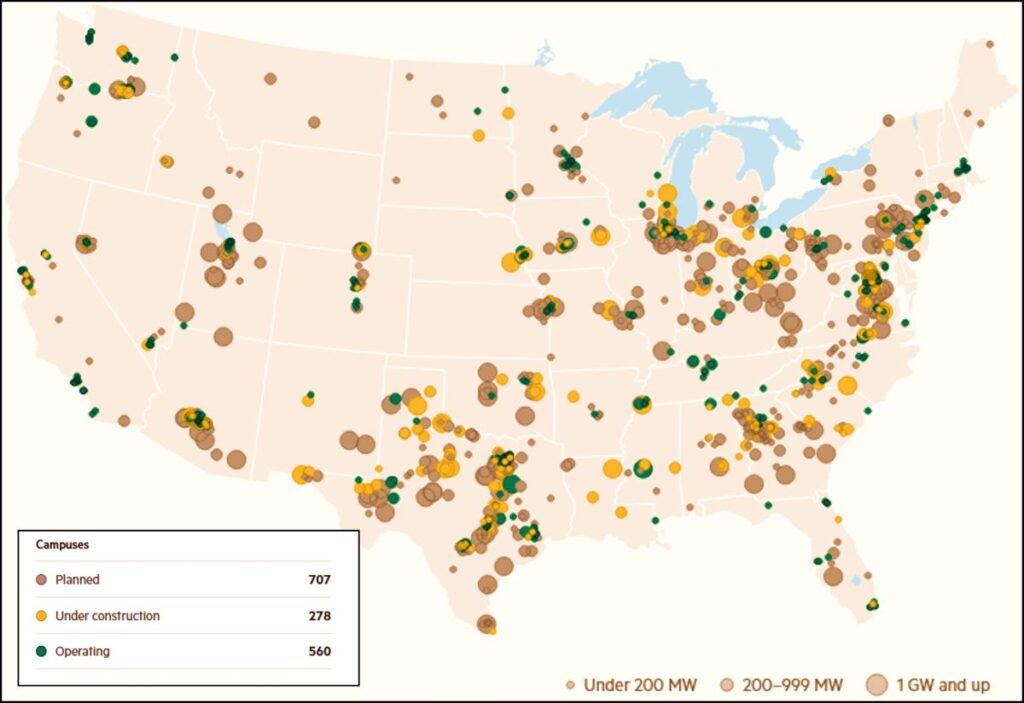
I report Data center activity in the next figure, which shows actual and planned construction across the United States as of November 2026. The activity is widespread and growing. Reactions to the massive level of activities have raised the concerns of people in data center neighborhoods and generated a sympathetic mid-term response. As with most massive construction activity in our past—railroads, dams, bridges, and mega-shopping centers, new rules and regulation emerge when we learn about the effects of massive change. It’s safe to say acceleration in the pace of data center construction will slow down and reduce the pace of future GDP growth.
Consumer Spending
Growth in consumer spending was the other main 3Q2026 GDP driver. in spite of $4.00 gasoline, artificial intelligence-induced job uncertainty and what seem to be endless and tragic wars in the Middle East and between Russia and Ukraine, sharply rising stock market averages, where more than 74% of U.S. households are invested directly and indirectly, added a powerful spending stimulus.
When growth in wealth is considered, the K-shaped economy metaphor used frequently to describe how U.S. income is being distributed across families and individuals needs to be examined more closely. In a K economy one large segment of consumer/producers does well—the upper leg—while those remaining face diminishing prosperity. But that’s about income. What about wealth? Jared Brikley reports a reassessment in a Yahoo Finance analysis. Using Federal Reserve survey data, the analysis shows consumer spending has grown about 4% to 5% a year for every income group since 2024. Household net worth is up more than 70% for every income group since early 2019, including about 73% for the lowest-earning fifth and 85% for the top 1%. Yes, there is a mixed economy buried in the data, but it is one where all income groups see improvements. Of course, some “are more equal than others.”
All That Glitters Isn’t Gold
The Commerce Department report that showed strong third-quarter GDP growth brought bad news for those worried about inflation. And who among us isn’t? The Fed’s preferred inflation metric, the Personal Consumption Expenditure Index, which closely correlates with the all-items Consumer Price Index, showed an annual increase of 3.6%. On a month-over-month basis it was rising, not falling. Yes, we may be getting wealthier—on average—and participating in a growing economy, but the purchasing power of our paper money is disappearing at a faster clip.
It may be worth remembering that inflation occurs when the prices of all goods and services taken together are rising, not just when the price of gasoline jumps to $4.00 a gallon, which is a relative price increase. To get to inflation, the prices of gasoline and everything together, head north. And for that to happen, our shepherd(?!), the U.S. government, has to print more money. Otherwise, if the price of one item rises in the consumer’s budget, the price of something else has to fall, this so long as the supply of money is the same.
The federal government prints more money by buying outstanding federal debt or by spending more on government activities enabled by issuing new debt. And that is exactly what is happening.
The next chart shows data on money supply growth, in this case what is called M2, and growth in the Consumer Price Index for the last 12 months. The relationship is apparent and for those truly concerned about inflation, concerning.
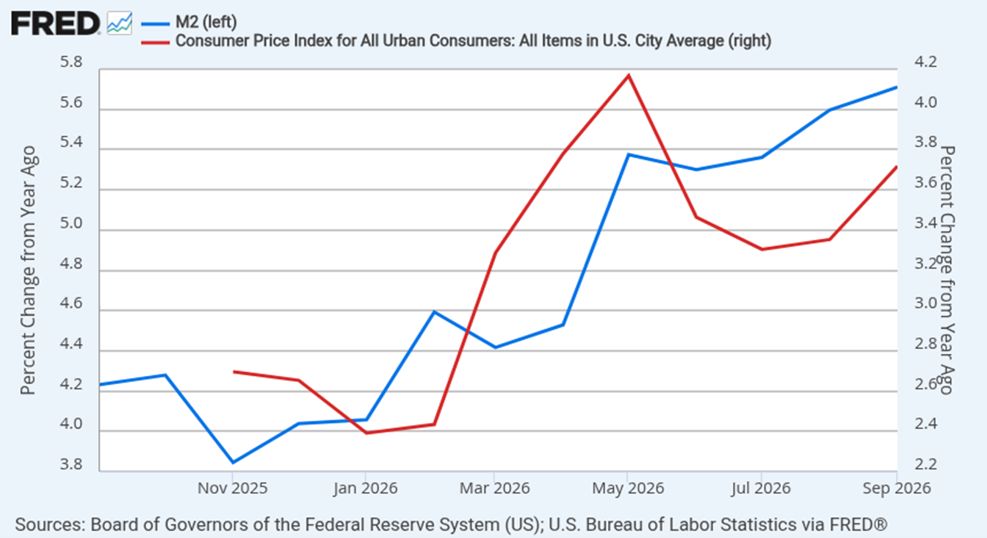
Those who wish to put inflation in reverse gear must do more than end the war in Iran and eliminate tariffs on a large swath of goods consumers buy every day. They must slow down the money machine, and that means cutting back on deficits, which is a lot to expect from the next congress.
Final Thoughts
As we survey the 2026 year-end political economy, we see strong income growth and stable employment across most of the United States. Driven primarily by AI-related business construction and supported by strong consumer spending, albeit at a diminished pace, the 2027 U.S. economy should continue to rack up real GDP growth in the range of 2.0% to 2.5%. Unfortunately, there is nothing on the horizon to suggest that we will see significantly lower inflation. But there are good reasons to believe that we will see relief in the form of lower energy and food prices. Funded with growing federal debt and investment income, we Americans will continue to consume more each month than we produce. It is unlikely that we are ready to break the government habit.