Slow & Steady Progress Repairing America’s Bridges, According to Latest Federal Government Data
Nearly 221,800 U.S. bridges need major repair or replacement, an American Road & Transportation Builders Association (ARTBA) analysis of recently released federal government data shows.

Placed end-to-end, these structures span over 6,100 miles, or the equivalent of every mile of urban and rural Interstate in California, Florida, and Illinois.
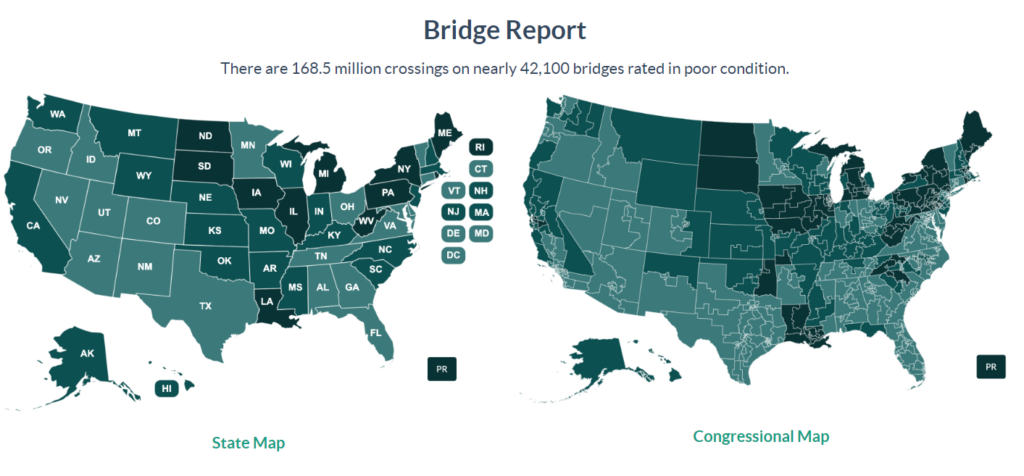
Of the bridges needing repair, 42,067 are rated in poor condition and classified as “structurally deficient.” That is 324 fewer than in 2023.
States with the biggest decline in the number of bridges in poor condition: Pennsylvania (down 90), Louisiana (down 87), Florida (down 85), West Virginia (down 74), and California (down 64).
Bridges in poor condition represent 6.8 percent of the 2024 U.S. bridge inventory—compared to 7.3 percent in 2020.
“Over the last five years we have seen significant progress in states like Oklahoma, Pennsylvania, Mississippi, Louisiana, and West Virginia – reducing the number of bridges in poor condition,” said Dr. Alison Premo Black, ARTBA’s chief economist, who conducted the analysis. “While improvements can take time, every bridge repair increases the safety and efficiency of our network for the traveling public.”
States have received $15.9 billion in the first three years of the IIJA’s new $27.5 billion formula bridge program and, to date, have committed 46 percent ($7.3 billion) of these resources to over 4,170 bridge projects.
The remaining 54 percent ($8.5 billion) of already released bridge funds – plus the $10.6 billion that will be provided in the next two years – will support needed bridge improvements well into the future.
Twenty-three states have committed at least half of their available bridge formula funds, with the top 10 being: Georgia (100%), North Dakota (99%), Indiana (98%), Florida (96%), Oklahoma (95%), Nebraska (91.5%), Idaho (91.5%), Arkansas (88%), West Virginia (85%) and Alabama (85%).
Bridges that have come off the “poor condition” list include:
- I-695 over U.S. 40, Md.
- I-93 over Conley Street, Mass.
- I-680 over Capitol Avenue, Calif.
- I-55 over Madison Street, Ill.
- I-95 over Route 608, Va.
Bridges newly rated in poor condition include:
- I-90 over Canal to Stewart Streets, Ill.
- Interstate 680 over Monument Boulevard, Calif.
- I-93 over Mystic Valley Parkway, Mass.
- I-95 North and Southbound over Thurbers Avenue, R.I.
- IH-35 over Grand Avenue, Texas
Based on average cost data submitted by states to the U.S. Department of Transportation, ARTBA estimates it would cost over $400 billion to make all needed repairs to the 221,800 structures.
About the Report
The data in the report is from the Federal Highway Administration’s National Bridge Inventory (NBI), downloaded on August 20. Specific conditions on bridges may have changed because of recent work or updated inspections.
Bridges are classified in good, fair, or poor condition based on their inspection ratings and definitions from U.S. DOT.
The definition of “poor” is when a key element of the bridge—the deck, superstructure, substructure, or culverts, are rated in poor or worse condition. During inspection, the conditions of a variety of bridge elements are rated on a scale of 0 (failed condition) to 9 (excellent condition). A rating of 4 is considered “poor” condition.
About ARTBA
Established in 1902, the Washington, D.C.-based ARTBA brings together all facets of the transportation construction industry to responsibly advocate for infrastructure investment and policy that meet the nation’s need for safe and efficient travel.