AI Changes Construction Twice: How the Data Center Boom is Rewriting Project Risk
For the construction industry, most conversations about artificial intelligence have focused on how AI will change the way we work: estimating faster, automating documentation, improving schedules, analyzing risk and helping project teams make better decisions.
But AI is changing construction a second way that may prove just as consequential.
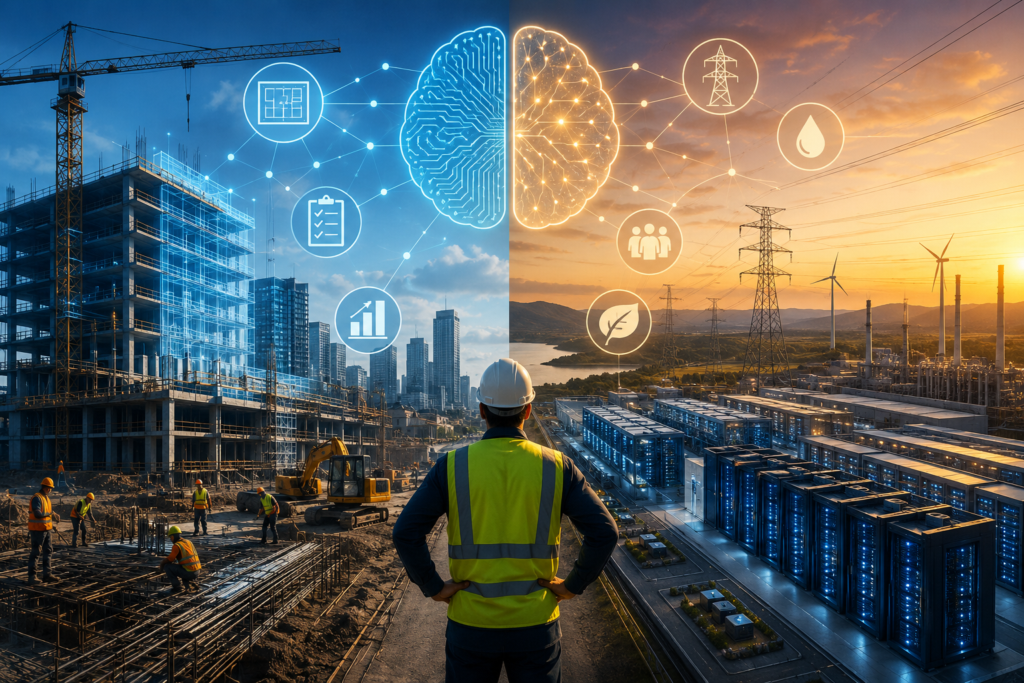
AI is changing what the world needs us to build.
The extraordinary capital flowing into artificial intelligence is creating demand for data centers, power generation, transmission infrastructure, manufacturing facilities, cooling systems and an entirely new ecosystem of supporting infrastructure.
And as those projects become larger, faster and more resource-intensive, they are also changing the definition of project risk.
Capital Is Starting to Ask Different Questions
A recent Reuters report provides an important signal.
Lenders financing U.S. data center development are increasing their scrutiny of permitting, community acceptance and political risk as they evaluate projects. In the first quarter of 2026 alone, at least 75 proposed data center projects representing approximately $130 billion of investment encountered local opposition, according to Data Center Watch data cited by Reuters.
Bank of America told Reuters that project readiness increasingly includes not only permits and approvals but also support from the communities surrounding the development. Other lenders are similarly evaluating community sentiment and the possibility that opposition could delay—or ultimately kill—a project.
That is a meaningful development for the construction industry.
Traditionally, contractors tend to think about project risk through familiar categories: labor, schedule, material availability, subcontractor performance, safety, cost escalation and constructability.
Those issues remain.
But on the next generation of AI infrastructure projects, the project’s external environment is becoming part of the construction risk equation.
The Constraint Is No Longer Just the Building
A hyperscale data center is not simply a very large building filled with servers.
It is effectively an infrastructure system.
It needs enormous quantities of reliable electricity. Depending on cooling technology and location, it may require significant water resources. It requires transmission and utility infrastructure, network connectivity, land, equipment and skilled labor.
And communities increasingly understand those impacts.
A June Reuters/Ipsos poll found substantial public concern surrounding rapid data center development, including worries about electricity prices, water consumption, land use and the economic benefits communities actually receive.
Those concerns are beginning to translate into public policy. North Carolina lawmakers, for example, have considered additional guardrails around data center development as municipalities wrestle with concerns involving noise, infrastructure and electricity costs.
Meanwhile, Duke Energy is planning major infrastructure investments across the Carolinas to accommodate population growth, advanced manufacturing and data center demand while protecting reliability and existing customers.
This is no longer a theoretical issue.
It is becoming part of site selection, financing and project delivery.
What This Means for Contractors
The implication is straightforward: owners will increasingly need contractors that can help manage more than construction execution.
On major AI infrastructure programs, competitive contractors will need capabilities—or strong partners—across a much broader range of issues.
Power availability
Power may increasingly determine whether a project proceeds at all.
The U.S. Energy Information Administration expects data centers to be an important driver of the strongest four-year growth in U.S. electricity demand since 2000. Its longer-range scenarios show data center server electricity consumption expanding substantially as computing requirements grow.
That means electrical infrastructure, substations, transmission, generation, storage and utility coordination are becoming central components of the development strategy—not downstream construction scopes.
Water and environmental constraints
Water availability, cooling strategies, noise, emissions and land use can become community issues long before contractors mobilize.
Projects that ignore those concerns during development may discover that the critical path runs through a public hearing rather than the construction schedule.
Permitting and community engagement
Permits have always mattered.
What is changing is the importance of social permission to build.
Local communities increasingly want to understand who benefits from these projects, what they will cost ratepayers, how many permanent jobs they will create and how they will affect local infrastructure.
Contractors that understand these issues can become valuable partners much earlier in the project lifecycle.
Workforce planning
Mega-projects can quickly overwhelm regional labor markets.
Owners will increasingly expect contractors to demonstrate not merely how many workers they need, but where those workers will come from, how they will be trained and how the project will avoid destabilizing other regional construction activity.
Supply-chain certainty
Transformers, switchgear, generators, cooling equipment and other mission-critical systems can carry long lead times.
Procurement therefore becomes part of the project’s strategic planning much earlier than traditional construction delivery models might suggest.
Modularization and advanced fabrication
Schedule pressure and labor constraints will continue pushing more work away from the jobsite.
Electrical skids, modular power systems, prefabricated assemblies and other offsite solutions may become increasingly important to delivering AI infrastructure at the speed owners expect.
Scenario planning
Perhaps most importantly, owners will need contractors capable of helping answer questions that do not have simple answers.
What happens if utility power arrives six months late?
What happens if permitting changes?
What happens if equipment lead times increase?
What happens if the labor market tightens?
What happens if the owner wants to accelerate the project by four months?
The contractor of the future will increasingly need to help owners model those alternatives before they become project crises.
The Carolinas Have an Opportunity
This matters particularly for contractors across North and South Carolina.
The Southeast continues to attract major investment in advanced manufacturing, energy infrastructure and data centers. At the same time, regional utilities and policymakers are wrestling with how to accommodate unprecedented electricity demand while preserving reliability, affordability and community support.
That combination creates opportunity—but it also raises the bar.
For contractors, the opportunity is not simply to chase the largest data center project that appears in the pipeline.
It is to develop capabilities around the infrastructure behind the data center:
Power.
Electrical systems.
Advanced fabrication.
Automation.
Utility infrastructure.
Commissioning.
Service and maintenance.
Those markets may ultimately provide opportunities far beyond the data center itself.
AI Changes Construction Twice
There is a tendency to think about artificial intelligence primarily as another construction technology.
That understates what is happening.
AI changes construction once by changing how we build.
It can transform estimating, planning, design coordination, safety, project controls and decision-making.
But AI changes construction a second time by changing what society needs us to build.
It is driving enormous investment into computing infrastructure, power generation, transmission, manufacturing and the physical systems that make the digital economy possible.
That second transformation may ultimately be larger than the first.
And it creates a new challenge for contractors.
The companies positioned to win this work will not simply be the organizations capable of constructing the building.
They will be the organizations capable of helping owners navigate the increasingly complex system surrounding it—power, water, permitting, community acceptance, workforce, supply chain, schedule and risk.
The future contractor may increasingly be measured not only by the ability to build the project.
But by the ability to help make the project possible in the first place.
Sources
Reuters — “Lenders scrutinize US data center financing as community opposition builds,” Aug. 10, 2026
https://www.reuters.com/legal/transactional/lenders-scrutinize-us-data-center-financing-community-opposition-builds-2026-08-10/
Reuters — “Americans wary of AI-driven data center boom, Reuters/Ipsos poll shows,” June 11, 2026
https://www.reuters.com/world/us/americans-wary-ai-driven-data-center-boom-reutersipsos-poll-shows-2026-06-11/
Reuters — National data center opposition, July 18, 2026
https://www.reuters.com/business/retail-consumer/us-data-center-protests-go-national-backlash-grows-2026-07-18/
U.S. Energy Information Administration — Data center server electricity demand
https://www.eia.gov/todayinenergy/detail.php?id=67704
Duke Energy — Data center growth and Carolinas infrastructure
https://news.duke-energy.com/releases/duke-energy-data-center-growth-will-deliver-billions-of-dollars-in-customer-savings