

How AI is Reshaping the Industrial Deal Cycle
Artificial intelligence is beginning to transform how industrial real estate deals are sourced, evaluated, negotiated, and executed. At the recent NAIOP I.CON West conference in Los Angeles, industry leaders discussed how rapidly advancing AI capabilities are changing the speed and structure of the development and investment process.
In a panel moderated by Denice Tokunaga, partner at Seyfarth Shaw LLP, experts from across the industrial real estate ecosystem explored the opportunities and risks associated with AI adoption. Panelists included Jay Carle, partner at Seyfarth Shaw; Chris Karacic, due diligence director at LBA Realty; Will Pearce, CEO and co-founder of Orbital; and Maria Poyer, head of acquisitions at Verrus.
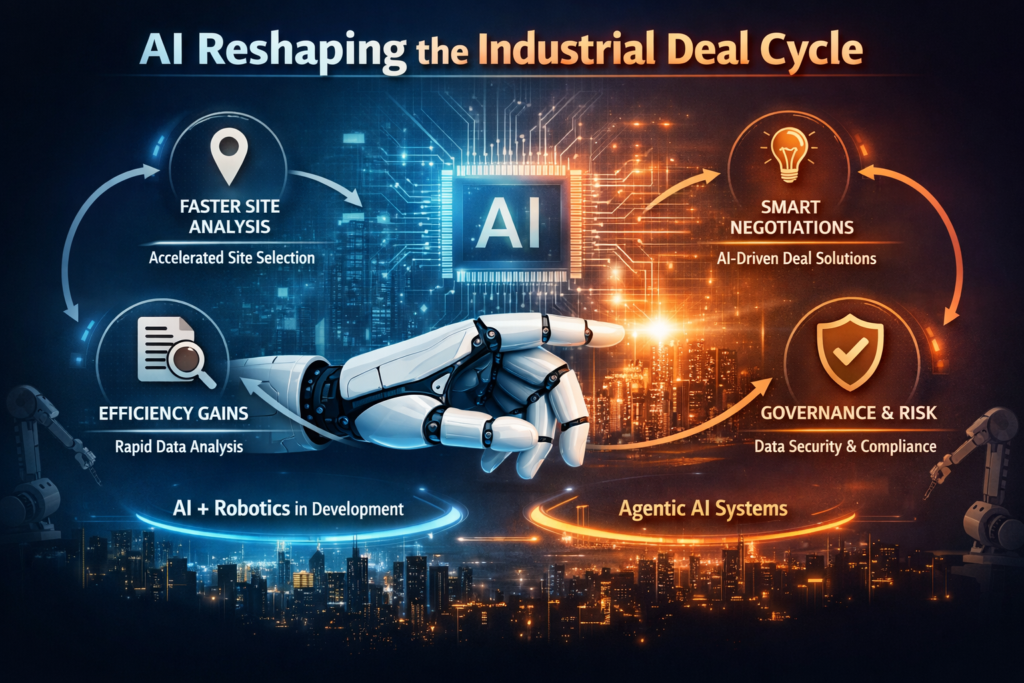
One of the most immediate impacts of AI is the dramatic acceleration of early-stage site analysis. According to Poyer, AI-powered platforms can now complete in a single day what once required weeks of analyst time.
“Really what that means is the speed of knowing site constraints is much faster,” Poyer said during the discussion. “And in the development cycle, that’s everything.”
Faster analysis allows development and acquisition teams to evaluate more opportunities in less time, improving the ability to quickly identify viable projects and move forward with confidence.
AI is also reducing the time required for routine analytical tasks such as compiling jurisdictional data, summarizing complex leases, and reviewing tenant financial profiles. Poyer noted that while there is concern about AI replacing certain roles, the technology is more likely to shift how professionals spend their time.
“It’s just transferring the type of analysis that needs to be done by junior folks and senior folks,” she said, allowing teams to focus more on strategic decision-making rather than manual data review.
Karacic highlighted how AI can also assist in solving complex deal challenges. When unexpected issues arise during negotiations, AI tools can quickly generate potential solutions or alternative approaches, providing teams with new ideas to consider during negotiations.
From a technology perspective, Pearce emphasized that AI represents a major technological shift that will impact nearly every stage of a transaction that relies on reasoning, pattern recognition, or analysis. He noted that AI capabilities are advancing rapidly, with some models doubling in capability roughly every seven months.
However, panelists also stressed the importance of governance and risk management as organizations adopt these technologies.
Carle cautioned that while AI development is moving quickly, legal frameworks and corporate governance structures often evolve more slowly. Companies must establish clear policies governing how AI tools are used, particularly when handling sensitive information.
Confidential financial data, investor information, and proprietary lease terms should never be uploaded into publicly accessible AI systems without safeguards. Firms should implement validation procedures, audit trails, and clear protocols that ensure a “human in the loop” for major financial decisions and underwriting models.
Looking ahead, panelists expect the next phase of transformation to come from the integration of AI with robotics and autonomous systems, particularly in the construction and development phases of real estate projects.
In the nearer term, Karacic pointed to the rise of “agentic AI”—systems capable of executing multiple analytical steps autonomously. Instead of prompting AI tools repeatedly for separate tasks, these systems could manage entire due diligence workflows on their own.
For example, an AI system could review environmental reports, assess potential risks, and automatically adjust financial underwriting assumptions based on the findings.
Pearce described the broader impact as a technological flywheel: as AI capabilities improve, the speed at which new AI tools are developed also increases, accelerating innovation across the industry.
“I think things are going to get pretty scary pretty quickly,” Pearce said, adding that the opportunities created by AI will ultimately reshape how real estate deals are structured and executed.
This article summarizes insights from “AI is Rapidly Rewriting the Industrial Deal Cycle,” written by Brielle Scott, Director of Marketing and Communications at NAIOP, published March 5, 2026 following NAIOP’s I.CON West conference in Los Angeles. The original conference blog post was sponsored by JLL.



