
Reading the Signs: Why Economic Indicators Matter for Construction Executives
Construction leaders often pride themselves on instinct—the ability to “read the market” from conversations with clients, lenders, or subcontractors. But in today’s environment of volatility and complexity, instinct alone is not enough. To build resilient, forward-looking strategies, construction executives must treat economic indicators the way builders treat blueprints: as essential guides to navigating uncertainty.
Why Economic Indicators Matter
Economic indicators are not abstract numbers meant for economists. They are signals—early warnings and leading lights—that shape demand for projects, cost of capital, workforce availability, and client confidence. For a construction firm, ignoring these signals is like building without a survey: you might get lucky, but you’re just as likely to misalign your foundation.
For example:
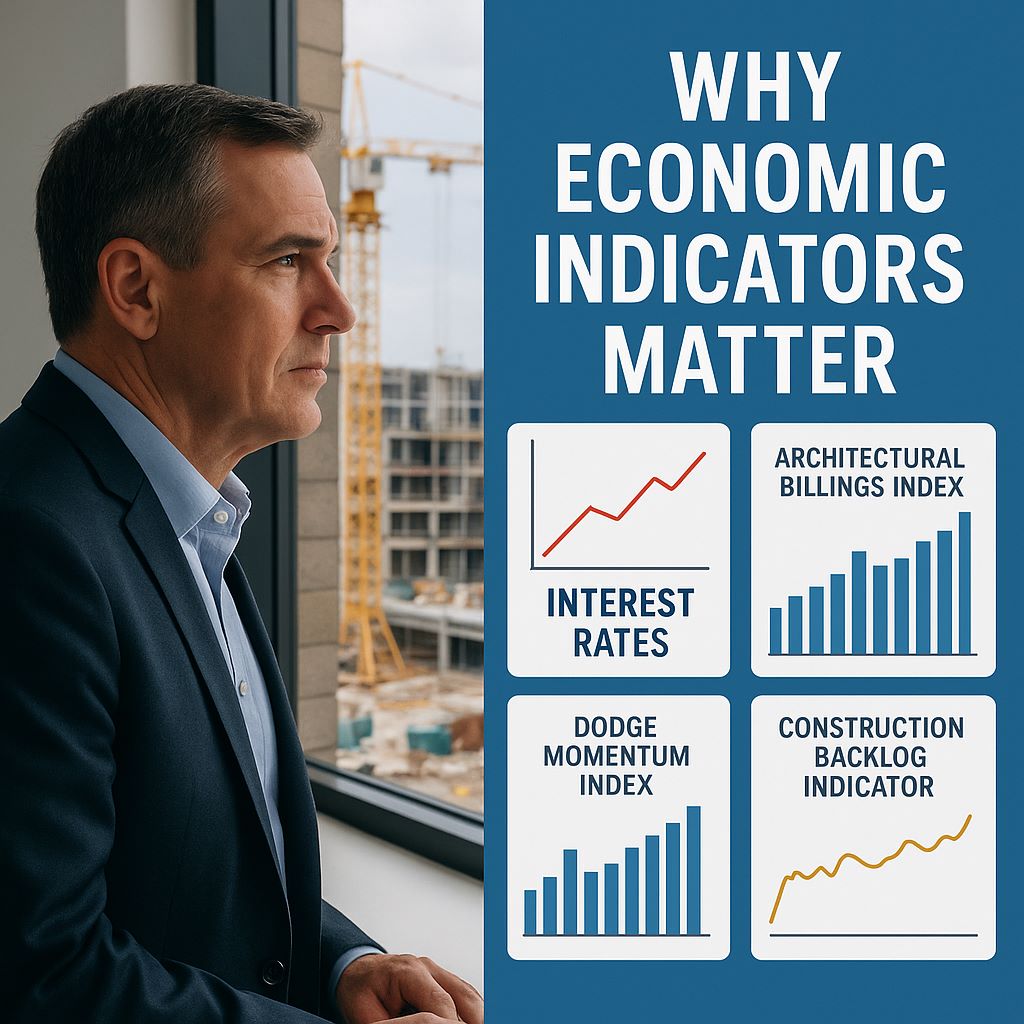
- Interest rates influence the cost of financing commercial and industrial projects. A sustained period of high rates often cools speculative development in sectors like multifamily and office.
- Architectural Billings Index (ABI), published by the AIA, is a leading indicator for construction activity nine to twelve months out. A drop in billings today often foreshadows weaker project starts next year.
- Dodge Momentum Index (DMI), tracking planning and design work, signals future nonresidential construction starts. A surge here can suggest a strong pipeline even if starts temporarily lag.
- Construction Backlog Indicator (ABC) gives insight into industry workload, showing if firms are holding steady or burning through committed work.
When executives align decisions with these signals, they move from reactive firefighting to proactive positioning.
Interpreting Trends Without Getting Lost in the Noise
Economic data can be overwhelming. The key is not to track everything but to interpret the right few indicators consistently. Consider a practical approach:
- Link Indicators to Business Segments
- If your firm builds manufacturing plants, track industrial production, reshoring trends, and PMI Manufacturing Index.
- If your work is in healthcare, watch state budget outlooks and demographics, since these drive capital investment in hospitals and senior care facilities.
- For commercial builders, consumer confidence, retail sales, and ISM Services PMI are crucial.
- Identify Turning Points
Look for inflection points rather than single data points. For example, the ABI consistently trending below 50 signals contraction in design activity, which may translate to weaker construction starts in the following year. - Balance Leading and Lagging Indicators
Lagging indicators (like construction employment) tell you where the market has been. Leading indicators (like the DMI) tell you where it’s headed. Executives need both to calibrate short-term adjustments and long-term bets.
“In God we trust. All others must bring data.” – W. Edwards Deming
Building a Process for Monitoring
Monitoring economic indicators should not be a once-a-year exercise before the strategic planning meeting. It requires a deliberate, repeatable process:
- Assign ownership – Designate a leader (finance, strategy, or BD) to collect and summarize economic updates monthly.
- Curate sources – Rely on trusted industry resources such as ABC’s Construction Confidence Index, AIA ABI reports, Dodge Data & Analytics, and CFMA’s Confindex survey.
- Visualize trends – Use dashboards or quarterly reports to track movement in interest rates, ABI, backlog, and sector-specific signals.
- Tie to decisions – Make indicator reviews part of project selection, risk assessment, and investment planning conversations. For example, if the DMI shows strength in data centers while commercial offices lag, reallocate resources accordingly.
Trend Examples in Action
- Data Centers: Surging demand tied to AI and cloud services is reflected in skyrocketing DMI readings in the mission-critical sector. Firms that spotted this trend early have positioned themselves as preferred partners for hyperscale developers.
- Manufacturing/Reshoring: U.S. industrial production data and federal incentives under the CHIPS and Science Act signaled opportunity well before groundbreakings. Executives who monitored these trends shifted capacity into semiconductor, battery, and advanced manufacturing projects.
- Healthcare: Demographic shifts (aging populations) combined with state-level spending data have pointed toward continued demand in healthcare facilities, even while office construction slowed.
- Interest Rates: The Federal Reserve’s extended high-rate stance cooled speculative commercial development. Builders who diversified into public infrastructure or industrial avoided exposure to stalled office projects.
From Information to Impact
Economic indicators are not predictions—they are signals. The difference lies in how leaders interpret and act on them. By institutionalizing a process to monitor, analyze, and integrate economic data into business decisions, construction executives can move from reactive builders to intentional strategists.
In construction, every project starts with a foundation. For leadership, that foundation is understanding the economic environment in which you build. The leaders who master this discipline don’t just survive cycles—they build firms that thrive through them.



