How the Biden Presidency Will Impact Construction
While final vote presidential votes tallies are still being calculated amid legal challenges, leaders of design and construction firms should prepare for how the new Biden presidency will impact the construction industry. From regulations and taxes, to renewable energy, infrastructure spending and immigration, the Biden administration will have a profound impact on the construction industry….

FMI Releases Fourth Quarter Heavy Civil Construction Index
FMI Corporation, the leading provider of consulting and investment banking services to the Built Environment, is pleased to announce the release of the fourth quarter 2020 Heavy Civil Construction Index (HCCI) report, which presents construction spending forecasts for transportation, highway and street construction segments. This quarter’s questions polled participants on trends affecting the competitive landscape, revenue expectations…
NAIOP Coronavirus Impact Survey: Deal Activity Increases but Rent Relief Requests Also Rise
In NAIOP’s sixth monthly survey tracking the effects of the pandemic on the commercial real estate industry, respondents reported continued gradual improvement in deal activity, but also reported more tenants seeking rent relief, particularly in the office sector. The survey was completed by 203 NAIOP members between September 15 – 18, 2020. Respondents represent a…
Interior Construction Guidance for Healthy Space Designs
When it comes to the interior construction work that you do for your clients, the top concerns that you are likely to get are related to cost, aesthetics, and speed. This makes a lot of sense on paper. After all, some of your customers may need their spaces made on a tight timeline. Of course,…
NAIOP Industrial Space Demand Forecast: While Long Term Growth Is Expected, Recession Will Have a Significant Impact on Industrial Real Estate Absorption Rates Into 2021
Although industrial real estate has outperformed other commercial property types this year due in part to a surge in e-commerce, broader macroeconomic indicators suggest industrial space absorption will decline sharply in Q3 2020 and then rebound to positive levels in Q2 2021, according to the NAIOP Industrial Space Demand Forecast, released today. Industrial net absorption is…
Architecture Billings Remain in Negative Territory, Begin to Stabilize
Demand for design services from architecture firms began to stabilize in June, following their peak declines in April, according to a new report today from The American Institute of Architects (AIA). AIA’s Architecture Billings Index (ABI) score for June was 40.0 compared to 32.0 in May. The May ABI score indicates that a significant share…
AIA Expresses Support for Moving Forward Act
The American Institute of Architects (AIA) is pledging support for the vertical infrastructure investments in the Moving Forward Act (H.R. 2), which is expected to receive a vote from the House of Representatives next week. As part of the proposed $1.5 trillion investment, the Moving Forward Act prioritizes $100 billion for facility upgrades at high-poverty schools,…
USGBC Releases New LEED Guidance to Address COVID-19 and Support Buildings with Reopening Strategies
The U.S. Green Building Council (USGBC) has released four new Safety First Pilot Credits in response to the Coronavirus Disease 2019 (COVID-19). The credits outline sustainable best practices that align with public health and industry guidelines related to cleaning and disinfecting, workplace re-occupancy, HVAC and plumbing operations. The credits can be used by LEED projects that are…
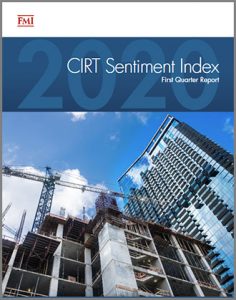
2020 CIRT Sentiment Index: First Quarter Report
FMI Corporation, the leading provider of consulting and investment banking services to the Built Environment, is pleased to announce the release of the first quarter 2020 CIRT Sentiment Index. The CIRT Sentiment Index is a survey, conducted quarterly by FMI, of members of the Construction Industry Round Table. The CIRT is composed exclusively of approximately…
Global Spending in Construction to Reach $17.5 Trillion by 2030, Finds Frost & Sullivan
The construction industry is in the middle of a transition toward new business models that are technology- and data-driven, better collaboration between stakeholders, and higher productivity. The increasingly aging workforce and digitization are prompting greater investments in workforce management and digital solutions. By 2030, global spending in construction is expected to touch $17.5 trillion, with China, the US, and India leading the way and accounting for…