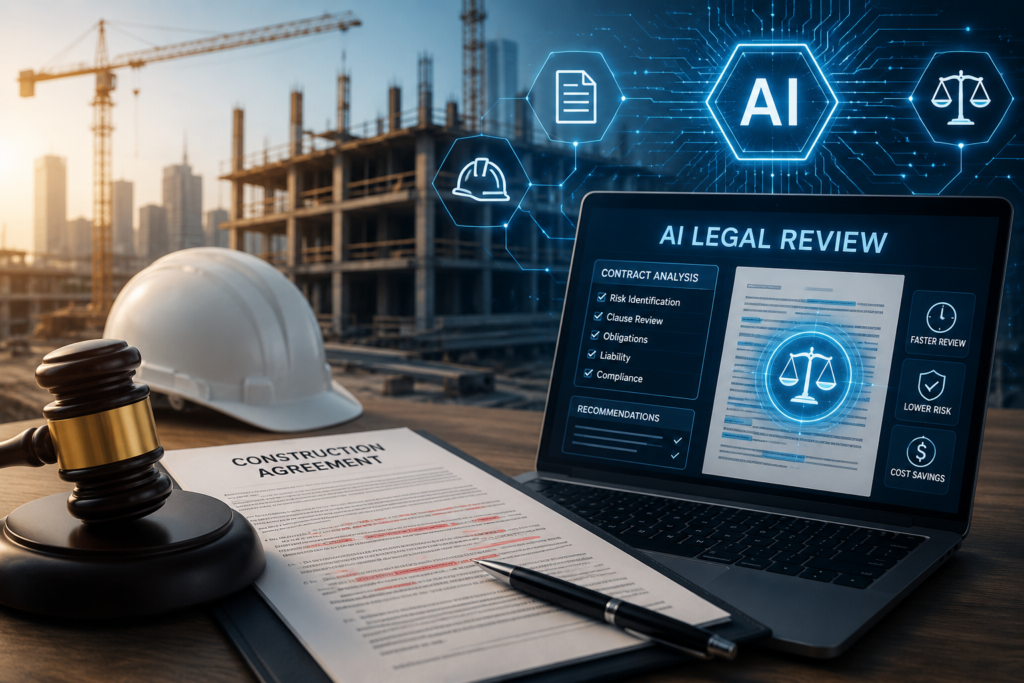
AI Law Firm Targets Construction Industry’s Contract Challenges
Artificial intelligence is rapidly reshaping construction, from estimating and scheduling to project controls and safety management. Now, legal services may be the next area poised for disruption.
Superlegal recently launched what it describes as the first AI-powered law firm authorized to practice law in the United States, with a particular focus on serving the construction industry. Operating under the Utah Supreme Court’s Legal Services Innovation Sandbox, the company combines artificial intelligence with attorney oversight to review and redline contracts for contractors, subcontractors, suppliers, and other businesses.
The announcement signals a potentially significant shift in how construction companies access legal services, particularly for the high volume of contracts that drive modern projects.
A Contract-Heavy Industry
Construction is one of the most contract-intensive industries in the economy.
From owner agreements and subcontracts to purchase orders, supplier contracts, equipment rentals, and professional services agreements, construction firms often manage hundreds of contracts on a single project.
For many companies, especially small and mid-sized contractors, obtaining timely legal review can be challenging. Traditional law firms often charge hundreds of dollars per hour, making it difficult to justify comprehensive review of every agreement.
At the same time, contract language can have significant consequences.
Scope disputes, payment issues, indemnification clauses, insurance requirements, schedule obligations, and risk transfer provisions remain among the leading causes of claims, delays, and litigation across the industry.
As project complexity increases and margins remain tight, contractors are increasingly looking for ways to improve contract management without dramatically increasing overhead costs.
Applying AI to Legal Review
Superlegal’s platform uses artificial intelligence to review commercial contracts and generate redlines before a licensed attorney provides final approval.
According to the company, contracts can be reviewed in less than 24 hours, with pricing designed to make legal review more accessible for businesses that manage large volumes of agreements.
The company says its technology was developed specifically for legal document analysis and trained on large datasets of legal contracts and related materials.
Unlike many legal technology providers that sell tools directly to law firms, Superlegal’s model is designed to provide legal services directly to businesses.
The company has established partnerships with industry organizations, including the Associated General Contractors of America, and reports construction clients ranging from specialty contractors to large infrastructure and utility organizations.
AI’s Growing Role in Construction
The timing reflects a broader trend occurring across the construction industry.
Recent industry surveys indicate that contractors are increasingly adopting AI for estimating, project planning, scheduling, business operations, safety, and design support. As organizations become more comfortable using AI in operational workflows, administrative functions such as contract management and legal review are becoming logical next steps.
The opportunity is significant.
Construction firms often process hundreds or even thousands of contracts annually. Automating portions of the review process could help organizations accelerate procurement, improve risk management, and reduce legal expenses while maintaining oversight from qualified attorneys.
According to customer results cited by Superlegal, organizations using the platform have reduced legal review costs by as much as 90% while significantly shortening review cycles.
What It Could Mean for Contractors
While AI will not replace attorneys in complex disputes, claims, litigation, or highly specialized legal matters, it may change how routine contract review is handled.
For contractors, owners, and suppliers, faster access to legal review could help reduce bottlenecks in procurement and project startup while providing greater consistency in risk assessment.
The emergence of AI-enabled legal services also reflects a larger trend across the built environment: professional services traditionally viewed as expensive and difficult to scale are increasingly being augmented by artificial intelligence.
Much like AI is helping estimators evaluate bids faster, project managers identify risks earlier, and business developers qualify opportunities more efficiently, legal review may be entering a similar phase of transformation.
A Glimpse of What’s Next
The launch of an AI-powered law firm raises broader questions about how professional services will evolve in the years ahead.
Construction companies have historically been cautious adopters of legal technology, but growing project complexity, workforce shortages, and pressure to improve productivity are creating incentives to explore new approaches.
Whether AI law firms become commonplace remains to be seen. What is clear is that contract management, one of the industry’s most critical and often overlooked functions, is becoming part of the construction technology conversation.
For an industry built on agreements, risk allocation, and contractual obligations, that development could prove as impactful as many of the technological advances occurring in the field itself.