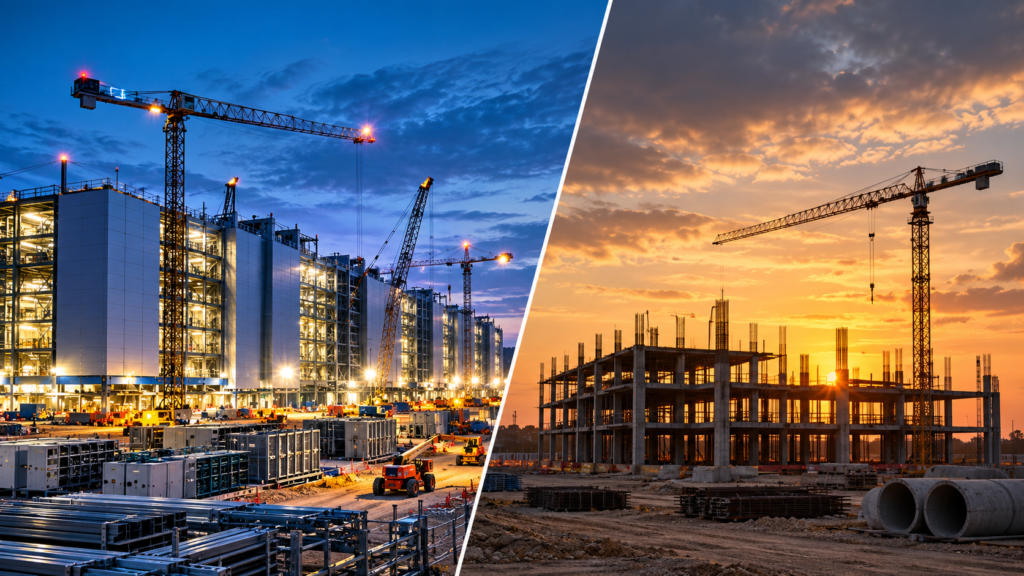
Construction’s Two-Speed Economy
The headline numbers still suggest a reasonably healthy construction market.
Contractors are hiring. Backlog rebounded in August. Confidence remains positive. Billions of dollars continue flowing into major projects across the country.
But underneath those numbers, something more important is happening.
Construction is increasingly becoming a two-speed economy.
One part of the industry is being pulled forward by an extraordinary wave of investment in data centers, power infrastructure and the specialty trades needed to build them.
Much of the rest of the market is moving considerably slower.
That distinction may be one of the most important things construction leaders need to understand heading into 2027.
One Market Is Beginning to Distort the Numbers
The September economic roundup from Construction Executive provides a striking snapshot.
Nonresidential construction spending increased in July, but the increase was entirely attributable to data center construction. Excluding data centers, nonresidential spending declined for the second consecutive month and fell to its lowest level in nearly three years.
Power construction remains another area of strength, but even that story increasingly intersects with the data center boom as utilities, developers and technology companies race to secure the enormous amounts of electricity required by AI infrastructure.
In other words, what appears to be broad construction growth is increasingly concentrated around a relatively narrow ecosystem:
Data centers → power generation → transmission and distribution → electrical infrastructure → specialty trades.
That ecosystem is becoming one of the most powerful economic engines in construction.
The question is what the market looks like outside it.
The AI Buildout Is Becoming a Construction Buildout
It is increasingly difficult to separate the construction economy from the artificial intelligence investment cycle.
The massive capital flowing into AI is not staying inside technology companies.
It is cascading through the physical economy.
Data centers require power plants, substations, transmission lines, switchgear, generators, cooling systems, fiber networks, water infrastructure, manufacturing facilities and enormous amounts of electrical and mechanical construction.
The result is a multiplier effect that extends far beyond the data center itself.
This may ultimately become one of the defining characteristics of the current infrastructure cycle.
AI changes construction twice.
First, it changes how we design, estimate, plan and build projects.
But perhaps even more significantly in the near term, AI is changing what America needs to build.
That second effect is already reshaping capital spending.
The Labor Market Is Sending the Same Signal
Employment provides another clue.
Construction employment increased for the sixth consecutive month in August, with year-over-year employment growth reaching its strongest pace in approximately 18 months.
But once again, the growth is not evenly distributed.
Nonresidential specialty trade contractors are leading the hiring surge, driven partly by extraordinary demand for electricians and other skilled trades supporting data center and power projects.
That demand is beginning to collide with an old construction problem: labor availability.
Job openings across construction have moved back toward a two-year high, while contractors are increasingly identifying workforce shortages as a concern.
This creates an interesting paradox.
The industry needs workers because certain markets are booming.
But the workers needed for those markets are increasingly difficult to find.
For contractors, the strategic implication goes beyond recruiting.
Labor capacity itself is becoming a competitive advantage.
Companies capable of recruiting, developing and retaining skilled workers — while simultaneously increasing productivity through prefabrication, modularization, automation and better technology — will have substantially more flexibility in deciding which opportunities they pursue.
The Cost Squeeze Is Returning
At the same time, the cost environment is becoming more difficult.
Construction input prices increased another 1.2% in August and were 8.9% higher than a year earlier.
The increases are not isolated.
Iron and steel, lumber, switchgear, copper wire and cable and several derivative metal products have experienced double-digit year-over-year increases.
For electrical and mechanical contractors in particular, that list should get attention.
Many of the materials experiencing the greatest escalation are the same products experiencing extraordinary demand from data centers, power projects and advanced manufacturing.
Add higher fuel costs, labor pressure and elevated borrowing costs and contractors face a familiar problem:
Strong demand does not automatically produce strong margins.
Revenue can grow while profitability deteriorates.
That makes estimating discipline, procurement strategy, contract language, escalation clauses and project selection increasingly important.
Backlog Is Healthy — But Backlog Alone Can Be Misleading
There is still plenty of reason for optimism.
Associated Builders and Contractors’ Construction Backlog Indicator rebounded to 8.5 months in August, increasing half a month from July and remaining unchanged from one year earlier.
ABC’s Construction Confidence Index also indicates that contractors continue to expect growth in sales, margins and staffing during the next six months.
Those are encouraging signals.
But backlog should never be confused with profitability.
Eight months of well-priced, well-staffed work is an asset.
Eight months of poorly priced work purchased with escalating materials, scarce labor and expensive capital can become a liability.
The quality of backlog may therefore matter just as much as the quantity of backlog heading into 2027.
The Bigger Strategic Question
Construction leaders should resist the temptation to describe the current environment simply as a “good market” or a “bad market.”
It is neither.
It is a highly uneven market.
Data centers are booming.
Power infrastructure is strengthening.
Specialty electrical and mechanical trades are benefiting.
Other segments face much more challenging conditions.
And the same forces creating extraordinary opportunities are simultaneously creating new risks around labor, materials, financing and execution.
That means strategy matters more.
Contractors should be asking several questions:
- Where is our backlog actually coming from?
A growing backlog concentrated in weakening markets carries very different implications than one positioned around long-duration investment cycles. - Which second-order markets benefit from the AI infrastructure buildout?
The opportunity extends well beyond data center buildings into power, equipment manufacturing, prefabrication, automation, cooling, utilities and infrastructure. - Where are labor constraints going to appear first?
The competition for electricians and specialized technical talent may become one of the defining constraints of the next several years. - Are we pricing tomorrow’s costs using yesterday’s assumptions?
Material escalation can quickly turn attractive projects into margin problems. - Are we chasing revenue or building strategic position?
Not every growing market is equally attractive, and not every project deserves to be pursued.
Follow the Capital
There is a simple lesson emerging from the September numbers.
Follow the capital, not just the construction statistics.
Capital is pouring into artificial intelligence infrastructure, electrification and the power systems required to support them.
That investment is creating first-order construction opportunities in data centers.
It is creating second-order opportunities in power generation, transmission, electrical infrastructure and equipment manufacturing.
And it will create third-order opportunities in communities, transportation systems, industrial facilities, workforce development and supporting infrastructure surrounding those investments.
Those effects will not happen evenly across every geography or every contractor.
That is precisely why this moment matters.
The construction market isn’t simply expanding or contracting.
It is being reorganized.
The companies that understand where capital is moving — and build the workforce, capabilities and relationships necessary to follow it — will be positioned very differently from those waiting for the broader market to improve.
The September numbers aren’t flashing red.
But they aren’t giving construction leaders a green light to simply keep doing what they have been doing either.
They are sending a more important message:
The opportunity is real. The market is narrow. And strategy matters more than ever.