
The Great American Bread Machine and Future Prosperity
Getting Started
With America’s 250th birthday soon to be celebrated, we stop momentarily to see how the Great American Bread Machine, the economy, cheers us on as we pursue life, liberty and happiness. So far, so good, I would say. In fact, in spite of much done politically to direct the economy from the top down to achieve political party goals, what’s left of free markets still delivers the goods, just not quite as many.
We should certainly expect this to be the case. Simply stated, GDP growth is determined by two things, the growth in the number of hours worked each day added to the growth in how much is produced during those hours. Since the United States is no longer producing people; population growth is zero, and we are exporting large numbers by way of immigration control, GDP growth rests on productivity, and that rests primarily on AI. Within all this, it is the small business sector, the least controlled by government, that is generating large employment gains.
There are three major forces playing through the economy: the AI revolution with large investments in energy and service centers and trade wars and upward bound energy costs generated by the war with Iran that are disrupting life and economic activity. As to how things are taking shape, first estimates of first quarter, 2026, real GDP growth came in at 2.0%, which is pretty close to the 2.1% growth for the year in 2025. While this should make flat-earth fans happy, the estimate of current GDP inflation should make all of us worry.
The Fed-watched Personal Consumption Expenditure Index rose 3.5% from the previous month. February’s index rose 2.7%. I note that at their May meeting, the Fed signaled the possibility of significant inflation increases in the days ahead and shelved plans for interest rate cuts. Rising energy costs matter.
Again, we are in another period of slow growth and high inflation.
Government Uncertainty is a Problem
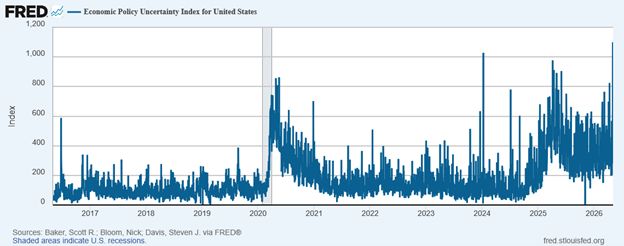
Any firm whose activities are significantly affected by federal government policies tends to hesitate when what the government may do next cannot be predicted accurately. Will my taxes rise nest year? Will tariffs be imposed on my products or my competitors’ products? Will my competitors be saved from bankruptcy? What about me? Will my manufacturing plants be raided by ICE and my workers taken into custody or shipped away? What about tariffs on what I use as major inputs—aluminum, steel, fertilizer? These are some of the policy questions firms across the United States are facing, and accurate prediction is partly determined by past behavior.
The next chart shows a plot of the daily Economic Policy Uncertainty Index for the United States from January 1, 2017 through May 4, 2026. It is based on the frequency of certain words found in 10 major daily U.S. newspapers along with data on tax code expirations and data on disagreement across economic forecasters. The chart’s last observation marks the day when Trump suddenly raised tariffs on German automobiles to 25% after having negotiated a 15% tariffs a few months earlier. It is the highest reading in the series. As can be seen, the 2025-2026 period forms a high-water mark for the series. With a promise of a pending golden age, President Trump uses uncertainty as a tool when negotiating trade and other matters. While better days may lie just around the corner, the Great American Bread Machine hesitates.
Looking at the States
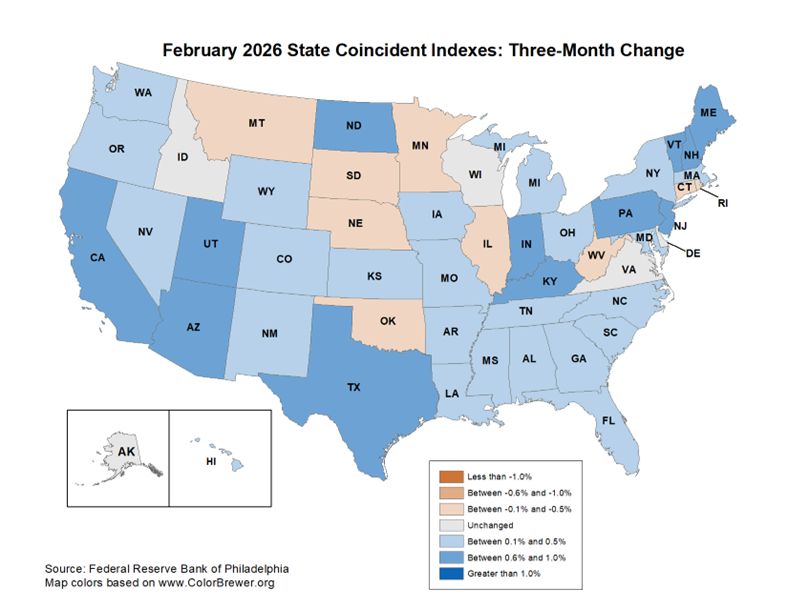
The next figure, produced by the Federal Reserve Bank of Philadelphia, reports February 2026 indicators for state economic activity based on employment and housing start data. Here we see the Carolinas and the entire Southeast region look good. Not great, but good. There is not a weak state in the larger neighborhood.
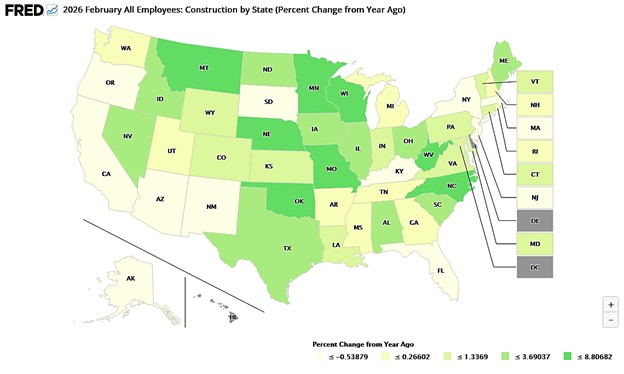
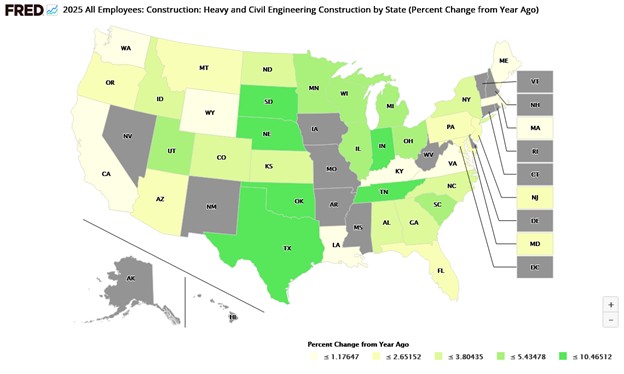
Looking at construction activity, the next two charts, produced by the Federal Reserve Bank of St. Louis, show first growth in state construction, year-over-year for February 2026 and next, employment growth in heavy civil and engineering construction for 2025. (The dark gray states are those for which there is no data.) In both cases, the two Carolinas show healthy levels of activity.
Final Thoughts
Given major global disruptions caused by explosive AI activities and the creative destruction generated by them, trade wars that are affecting prosperity prospects world-wide, and Middle East wars, there are times when it seems everything is coming unglued. We might say the world is in a disequilibrium and balancing forces are still at play. When this is the case, Candide’s advice may be the best to consider. Tend your garden and look out for your neighbor.