
What America’s Best Construction Projects Have in Common
Every contractor says they build quality projects. Every owner expects projects to finish safely, on schedule, and within budget. Yet anyone who has spent time in the construction industry knows those outcomes are far from guaranteed.
So what separates exceptional projects from merely successful ones?
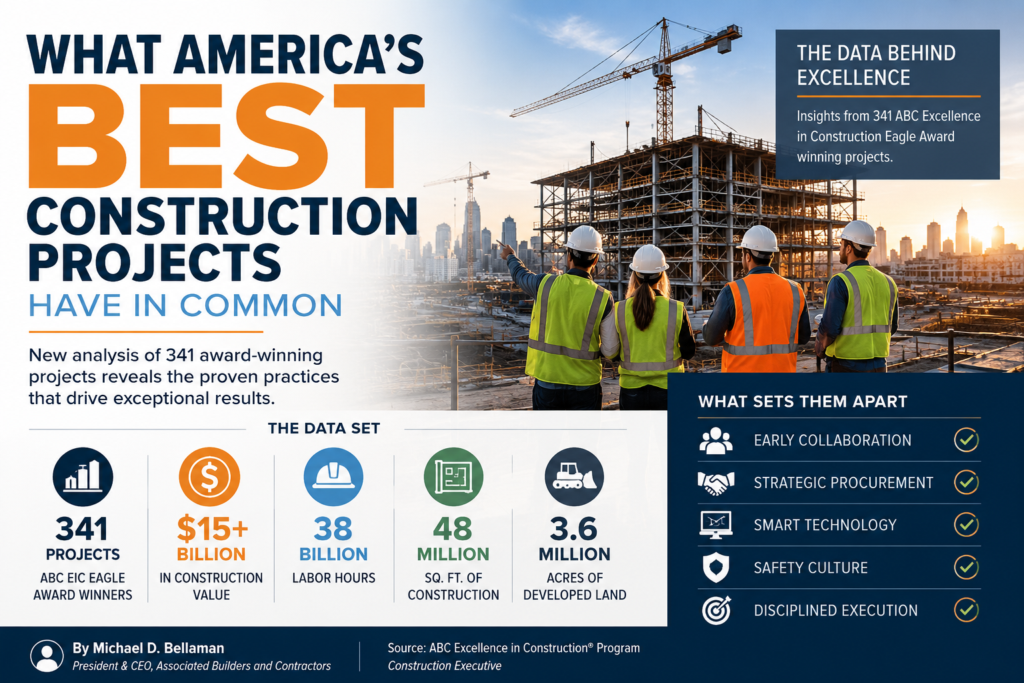
Michael Bellaman, President and CEO of the Associated Builders and Contractors (ABC), set out to answer that question in a recent Construction Executive article, Inside Construction’s Highest-Performing Projects. Rather than relying on anecdotes or opinions, Bellaman analyzed one of the industry’s richest sources of project-performance data: 341 ABC Excellence in Construction (EIC) Eagle Award-winning projects representing more than $15 billion in construction value, 38 million labor hours, 48 million square feet of construction, and 3.6 million acres of developed land.
That distinction matters.
The findings are based on standardized project data collected through ABC’s Excellence in Construction program, one of the industry’s premier national competitions recognizing outstanding construction projects for innovation, quality, safety, and execution. As ABC has modernized its awards process, it has created a database that allows researchers to identify measurable patterns among the nation’s highest-performing projects rather than simply celebrating individual success stories.
The results challenge several assumptions about project success.
Perhaps the biggest takeaway is that outstanding performance is not driven by project size or favorable market conditions. Instead, the highest-performing projects consistently shared common management practices that can be replicated across virtually every market sector.
Among the strongest findings was the value of early collaboration. Projects that engaged contractors during planning and preconstruction consistently produced better outcomes by improving constructability, reducing uncertainty, identifying risks sooner, and minimizing costly changes during execution. Rather than treating preconstruction as an expense, these organizations viewed it as an investment in project certainty.
Procurement strategy also emerged as a defining characteristic.
Bellaman’s analysis found that projects emphasizing qualifications, collaboration, and long-term value routinely outperformed those driven primarily by low bid selection. While competitive pricing remains important, the research reinforces what many experienced owners already recognize: selecting the right team often creates far greater value than selecting the lowest initial price.
Technology proved to be another differentiator.
High-performing projects were significantly more likely to leverage digital tools such as Building Information Modeling (BIM), drones, reality capture, digital project management platforms, and advanced scheduling technologies. These tools were not implemented simply because they were innovative; they improved communication, reduced rework, accelerated decision-making, and increased project visibility. Technology functioned as an operational advantage rather than a marketing feature.
The study also reinforced a lesson that construction leaders have understood for years but is now backed by meaningful data: safety and performance go hand in hand.
Exceptional safety performance was closely associated with superior schedule reliability, stronger budget performance, and higher overall project execution. Organizations that build strong safety cultures are also building stronger project management systems, better communication processes, and more disciplined operations. Safety becomes an indicator of organizational excellence rather than merely a compliance requirement.
Perhaps most encouraging was the overall performance of these projects.
According to Bellaman’s analysis, approximately 98% of the projects finished within their final contract budget while delivering safety results substantially better than industry averages. Those outcomes demonstrate that superior performance is not theoretical—it is being achieved every day by organizations that consistently execute proven management practices.
For construction executives, the implications extend well beyond project management.
As owners increasingly demand schedule certainty, cost predictability, transparency, and measurable outcomes, competitive advantage will belong to contractors who invest in collaboration, technology, planning, workforce development, and disciplined execution. These capabilities are becoming strategic differentiators that influence which firms win work and which firms build lasting client relationships.
Bellaman’s article ultimately delivers an optimistic message for the industry. Excellence is not random, nor is it reserved for a handful of elite contractors. The nation’s best projects reveal repeatable behaviors that any organization can adopt. In an industry facing labor shortages, growing complexity, and rising owner expectations, that may be the most valuable insight of all.
For construction leaders looking to improve project delivery rather than simply admire award-winning work, Michael Bellaman’s Inside Construction’s Highest-Performing Projects is well worth reading. It offers something increasingly rare in construction today: objective, evidence-based guidance drawn from the performance of hundreds of the industry’s most successful projects.