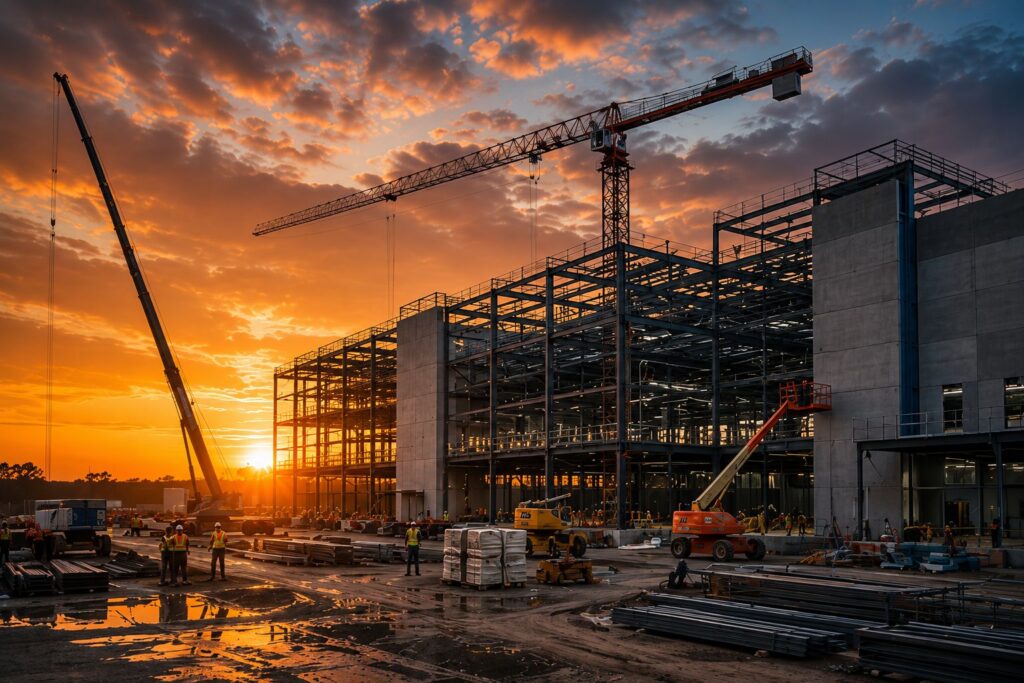
Why Meta and Google are Betting on Skilled Trades
For decades, workforce development followed a fairly predictable model.
Construction industry workforce programs focused on developing the skilled trades needed to build projects. Manufacturers invested in training programs designed to prepare workers to operate facilities once they opened. Utilities trained the technicians needed to maintain power systems. Each sector largely developed talent pipelines aligned with its own workforce needs.
The system was not perfect, but it generally worked.
Today, however, the lines are beginning to blur.
The rapid expansion of artificial intelligence, data centers, advanced manufacturing, and power infrastructure is creating demand for skilled labor on a scale few anticipated. The challenge is no longer simply finding workers to operate facilities after they are built. Companies must first find enough electricians, welders, pipefitters, fiber technicians, equipment operators, and construction professionals to build the facilities themselves.
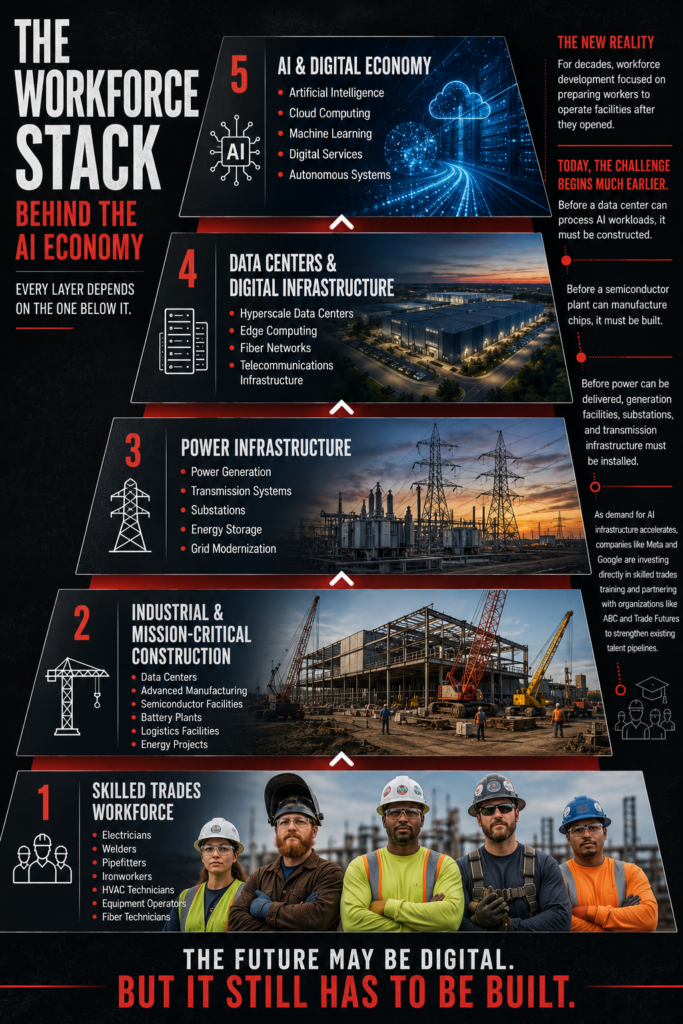
The AI economy is changing the workforce equation.
Every new data center requires thousands of skilled workers during construction. The power generation facilities, substations, transmission upgrades, and utility infrastructure needed to support those data centers require thousands more. Add in reshoring, advanced manufacturing, battery plants, semiconductor facilities, and infrastructure projects, and the competition for skilled labor becomes increasingly intense.
That reality helps explain why Meta and Google recently announced major investments in skilled trades workforce development.
While the headlines focused on dollars committed and workers trained, the bigger story is what these investments signal about the future of construction and economic development in America.
The nation’s largest technology companies have come to the same conclusion contractors have been discussing for years: labor availability has become one of the most significant constraints on growth.
The timing is not accidental.
America is simultaneously building data centers, advanced manufacturing facilities, semiconductor plants, battery factories, power generation projects, transmission infrastructure, logistics facilities, and healthcare campuses. The amount of construction activity occurring across multiple sectors at the same time is unprecedented.
The result is intense competition for the same electricians, welders, pipefitters, HVAC technicians, equipment operators, and construction professionals.
The challenge is particularly acute in states across the Carolinas and Southeast, where economic development success has attracted billions of dollars in new investment. Communities that once competed primarily for projects are increasingly competing for workers.
This is where the announcements from Meta and Google become significant.
Neither company is attempting to create an entirely new workforce ecosystem. Instead, they are partnering with organizations that have already spent years building training programs, apprenticeship pathways, and industry connections.
Meta’s partnership with Associated Builders and Contractors and Google’s support for workforce development initiatives reflect a recognition that the fastest path to success is strengthening existing infrastructure rather than starting from scratch.
That is an important signal.
For decades, contractors, trade associations, community colleges, workforce boards, and industry groups have been investing in craft training and career development. Programs like Trade Futures, apprenticeship initiatives, and contractor-led training academies have demonstrated that workforce challenges can be addressed when industry takes ownership of the solution.
What is different today is the level of owner engagement.
Historically, workforce development was often viewed as the responsibility of contractors, educators, and workforce agencies. Owners were beneficiaries of the outcome but not always active participants in the process.
That model is evolving.
Large project owners increasingly understand that workforce availability directly impacts project schedules, costs, and certainty of execution. If there are not enough qualified workers available, projects take longer, costs increase, and growth plans become more difficult to achieve.
The workforce issue has moved from a human resources discussion to a strategic business issue.
In many ways, this shift represents a natural evolution.
The construction industry has spent years building workforce development programs and advocating for careers in the skilled trades. Owners have now experienced the consequences of labor shortages firsthand through longer schedules, rising costs, and increasing competition for talent. The logical next step is direct investment.
For contractors and trade partners, this trend should be viewed as encouraging.
When some of the world’s largest companies begin investing in skilled trades, it elevates awareness of construction careers, expands training opportunities, and creates additional pathways for new workers to enter the industry.
Perhaps more importantly, it reinforces a message construction leaders have long understood: skilled trades are not a backup plan. They are a critical component of America’s economic future.
The AI revolution, reshoring movement, energy transition, and infrastructure expansion may be powered by technology, but they will be built by people.
Electricians will connect the power.
Pipefitters will install the systems.
Ironworkers will erect the structures.
Equipment operators will shape the sites.
Craft professionals will transform drawings and digital models into physical assets.
Meta and Google are not simply investing in workforce development programs. They are acknowledging a reality that the construction industry has known all along.
The future may be digital, but it still has to be built.