Power Constraints, Community Concerns Shape Next Wave of Data Center Growth
As artificial intelligence continues to fuel unprecedented demand for digital infrastructure, the challenge facing the data center industry is no longer demand. It is delivery.
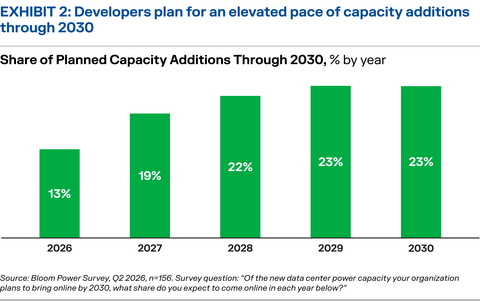
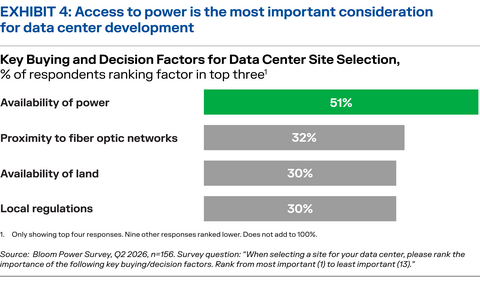
A new mid-year update to Bloom Energy’s 2026 Data Center Power Report finds that developers remain committed to aggressive expansion plans through the end of the decade, but access to power continues to be the single greatest obstacle to bringing projects online. The survey of data center developers, hyperscalers, colocation providers and chip manufacturers found that 61% of developers are prepared to bring their own power generation solutions if utility service is not available when needed.
The findings underscore a reality already familiar to many across the Carolinas and Southeast. Data centers are no longer competing only for land, labor and materials. They are increasingly competing for access to electricity.
The report notes that AI inference workloads now represent more than half of AI computing demand. As AI applications move from training models to real-world deployment, the need for additional data center capacity is expected to remain strong for years to come.
For construction and economic development professionals, the implications are significant. Demand for new facilities, substations, transmission infrastructure, backup generation systems and advanced cooling technologies is expected to remain robust. At the same time, project teams face a growing set of challenges that extend well beyond engineering and procurement.
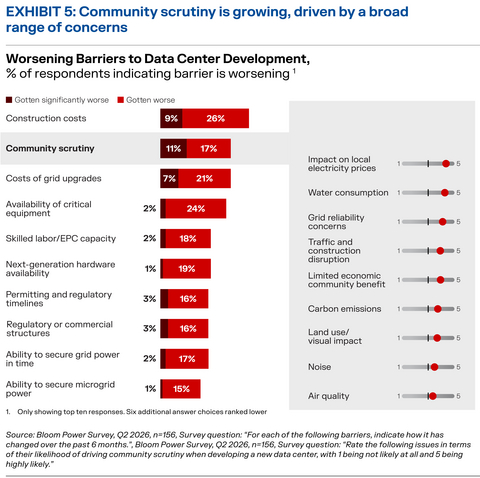
Community opposition is emerging as a major factor influencing project schedules and approvals. Developers surveyed cited concerns over electricity prices, water consumption and grid reliability as the issues most likely to impact future projects. Bloom Energy reported that as of May 2026, at least 18 state-level bills and 86 local moratoriums have been proposed across the United States related to data center development.
This marks an important shift. Historically, discussions around economic development focused on attracting investment and jobs. Today, communities are increasingly asking what the long-term impact of large-scale digital infrastructure will be on local resources and quality of life.
The report also highlights a growing technology readiness gap. Chip manufacturers expect high-density computing architectures and rack-level direct current power systems to become mainstream by 2028. Data center developers, however, anticipate a slower adoption timeline. That disconnect could create additional pressure on facility design, power distribution systems and construction schedules as AI hardware requirements continue to evolve.
Another emerging trend is the growing role of carbon capture technologies. Nearly one-third of data centers utilizing onsite power generation are expected to incorporate carbon capture solutions by 2030, reflecting efforts to balance growing energy demand with sustainability goals.
For contractors, utilities and infrastructure developers, the message is clear. The next generation of data center projects will require more than speed and scale. Success will depend on the ability to solve complex power challenges, engage communities early, and deliver infrastructure that supports both economic growth and long-term grid resilience.
The race to build AI infrastructure is accelerating. Whether projects move from announcement to operation may ultimately depend on who can deliver power first.