Raleigh’s Hidden Advantage on Flooding — and Why It’s No Longer Enough
Amid the ongoing recovery from Hurricane Helene, it may be hard to believe that Raleigh has a lot going for it when it comes to flood resilience. Rolling hills give heavy rainfall natural channels to flow through and out of the city.
But rainfall substantially exceeding normal amounts is becoming more frequent with climate change. Even between major storms like Helene, Raleigh’s topographic advantage is increasingly not enough to handle the sheer amount of rainfall occurring on a fairly regular basis.
I recently relocated to Raleigh from Norfolk, Virginia, one of the most flood-prone communities in the U.S. As an architect, I’ve had the opportunity to work on projects that face recurring coastal flooding.
While the extreme precipitation Raleigh is increasingly experiencing is a different problem, many of the techniques to address it are the same. Perhaps most important is a shift in mindset from storm prep to simply living with — and designing for — frequent water events. There are techniques designers apply that can be applied more broadly.
Flood mitigation in the air
Flood resilience is about managing the cycle of water, and for the buildings we design, that starts at the roof. Designs that slow, store and drain water during heavy rain alleviate the load on municipal drainage systems. At a minimum, structures need gutters and drains that are sized for future rain events, but there’s an array of effective and elegant rooftop solutions that go further.
In an urban environment, a green roof, covered in living plants, reduces runoff and filters pollutants through soil. Once 2-3 feet deep and extremely heavy, pre-manufactured (and in some cases pre-planted) 4-inch green roofs can now be installed over a standard roof without the need to increase weight bearing capability of the structure. The added maintenance is often offset by energy savings — green roofs can reduce the cooling load of a building by 70 percent (by both insulating and dispersing sunlight), while also protecting the roof membrane, extending its life by about 10 years. In addition, green roofs reduce the heat-island effect for the community.
A blue roof is an alternative for managing runoff during urban flooding. An absorbent material over the roof membrane acts like a sponge. Blue roofs require designing the roof with increased structural capacity, but the cost and maintenance are lower than a green roof. This technology combines well with using harvesting systems for irrigation as well as landscaping designed with “green sponge” zones to absorb and slow stormwater.
Managing water on the ground
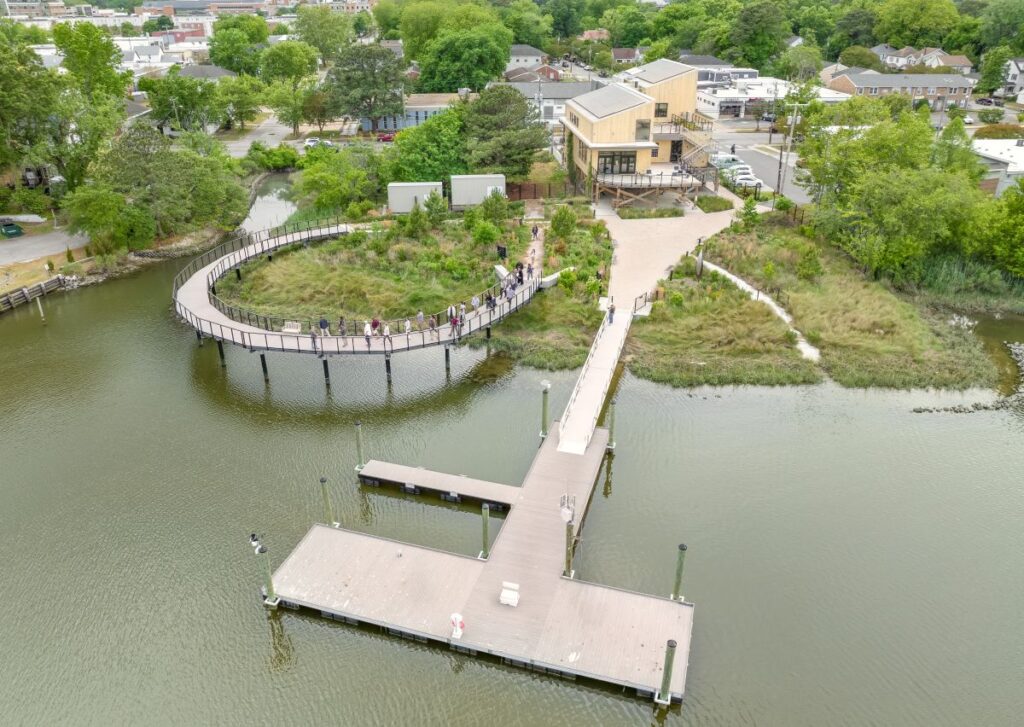
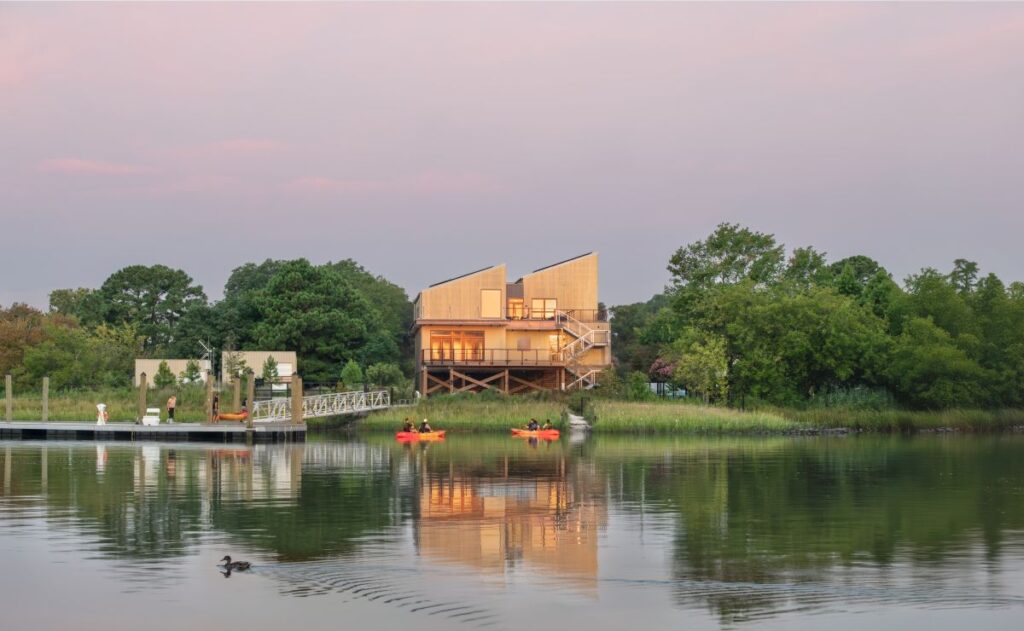
The Elizabeth River Project’s Ryan Resilience Lab was deliberately sited in a vulnerable floodplain in Norfolk to model how communities can live with, rather than retreat from, rising seas. As the lead designer on this project, I was presented with a unique challenge. Similarly to Raleigh, we couldn’t see floodwaters on most days at the site, but we knew they were coming.
Landscaping and paving are going to factor into almost any building. Treating them as parts of an overall green infrastructure site system, can be beneficial both for aesthetics and as a flood-mitigation strategy.
At the Resilience Lab, the entire building is raised a floor above ground level. The area around it, a former brownfield, features bio-based materials and permeable paving stones through rain gardens with native plants.
The approach can be applied at the neighborhood level as well. I’m one of many designers involved in transforming a 200-acre public housing project in Norfolk known as the St. Paul’s Transformation. The project includes converting underground stormwater systems into open, naturalized watercourses to store and treat runoff, resulting in 23 acres of multi-use park space, trails and pavilions.
Here in North Carolina, the state is engaged in the largest investment in flood mitigation in its history. The goal is to reduce flood risk and improve resiliency across six major river basins, including the Neuse River, which provides Raleigh’s drinking water.
As the state’s blueprint rolls out, local leaders as well as individual property owners and developers can simultaneously take advantage of local stormwater grants, while also introducing flood management steps that go beyond what was called or in the past.
Photos: The Elizabeth River Project’s Ryan Resilience Lab in Norfolk, Virginia, was designed by Work Program Architects as a living demonstration of climate resilience. Credit: Yuzhu Zheng.
Sam Bowling is managing principal of Work Program Architects’ Raleigh office.